MCQ
The correct $IUPAC$ name of $2-$ethyl$-3-$pentyne is :
  • A
    $3-$methyl hexyne$-4$
  • B
    $4-$ethyl pentyne$-2$
  • $4-$methyl hexyne$-2$
  • D
    None of these

Answer

Correct option: C.
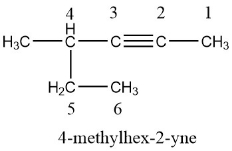
$4-$methyl hexyne$-2$
c
The correct numbering in the present case is one that gives lowest possible number to double bond, thus correct numbering to longest chain is given by:

Need a full question paper?

Generate a complete, print-ready paper with questions like this in minutes — across 16+ boards, with answer keys.
Start Generating Free

Similar questions

Predict stereochemistry of product when $d$ and $l$ -amine reacts with $l$-acid
At normal temperature, $X$ and $Y$
The surface of copper gets tarnished by the formation of copper oxide.
$N _2$ gas was passed to prevent the oxide formation during heating of copper at $1250 K$.
However, the $N _2$ gas contains $1$ mole $\%$ of water vapour as impurity.
The water vapour oxidises copper as per the reaction given below:$2 Cu ( s )+ H _2 O ( g ) \longrightarrow Cu _2 O ( s )+ H _2( g )$
$P _{ H _2}$ is the minimum partial pressure of $H _2$ (in bar) needed to prevent the oxidation at $1250 K$.
The value of $\ln \left( p _{ H _2}\right)$ is$. . . . .$
(Given: total pressure $=1$ bar, $R ($universal gas constant $) =8 JK ^{-1} mol ^{-1}, \ln (10)=2.3. Cu ( s )$ and $Cu _2 O ( s )$ are mutually immiscible.
At $1250 K : 2 Cu ( s )+1 / 2 O _2( g ) \longrightarrow Cu _2 O ( s ) ; \Delta G ^\theta=-78,000 J mol ^{-1}$
$H _2( g )+1 / 2 O _2( g ) \longrightarrow H _2 O ( g ) ; \Delta G ^\theta=-1,78,000 J mol ^{-1} ; G$ is the Gibbs energy)
How many litres of water must be added to $1\,\, litre$ of an aqueous solution of $HCl$ with a $pH$ of $1$ to create an aqueous solution with $pH$ of $2$?.......$L$
Catalyst decomposition of hydrogen peroxide is a ........ order reaction
The bond in the formation of fluorine molecule will be
Which of the following reaction is called as ‘Bouveault-Blanc reduction’
Two elements $X$ and $Y$have following electronic configurations $X = 1{s^2},\,\,2{s^2}\,2{p^6},\,\,3{s^2}3{p^6},\,\,4{s^2}$ and $Y = 1{s^2},\,\,2{s^2}\,2{p^6},\,\,3{s^2}3{p^5}$. The expected compound formed by combination of $X$ and $Y$ is
The molar heat of formation of $NH_4NO_{3(s)}$ is $-367.54\,kJ$ and those of $N_2O_{(g)}$ and $H_2O_{(l)}$ are $+ 81.46\,kJ$ and $-285.78\,kJ$ respectively at $25\,^oC$ and $1.0$ atmospheric pressure. Calculate $\Delta U$ at $25\,^oC$ for the reaction

$NH_4NO_{3(s)} \to N_2O_{(g)} + 2H_2O_{(l)}$ .....$kJ$

Which of the following liberate hydrogen on reaction with dilute ${H_2}S{O_4}$