MCQ
The correct $IUPAC$ name of the following compound is
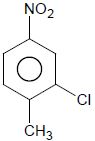
- A$5-$ chloro $-4-$ methyl $-1-$ nitrobenzene
- B$2-$ methyl $-5-$ nitro $-1-$ chlorobenzene
- C$3-$ chloro $-4-$ methyl $-1-$ nitrobenzene
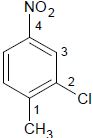
- ✓$2-$ chloro $-1-$ methyl $-4-$ nitrobenzene
Generate a complete, print-ready paper with questions like this in minutes — across 16+ boards, with answer keys.
($1$) The value of $x$ is. . . . .
($2$) The value of $y$ is. . . . .
Statement $I$ : The electronegativity of group $14$ elements from $\mathrm{Si}$ to $\mathrm{Pb}$ gradually decreases.
Statement $II$ : Group $14$ contains non-metallic, metallic, as well as metalloid elements.
In the light of the above statements, choose the most appropriate from the options given below :
$(A) i)$ Lindlar's catalyst, $H _2$; $ii$) $SnCl _2 / HCl$; iii) $NaBH _4$; iv) $H _3 O ^{+}$
$(B) i)$ Lindlar's catalyst, $H _2$; $ii$) $H _3 O ^{+}; iii)$ $SnCl _2 / HCl$; iv) $NaBH _4$
$(C) i)$ $NaBH _4; ii)$ $SnCl _2 / HCl; $iii$)$ $H _3 O ^{+}; iv)$ Lindlar's catalyst, $H _2$
$(D) i)$ Lindlar's catalyst, $H _2$; $ii$) $NaBH _4; iii)$ $SnCl _2 / HCl; iv)$ $H _3 O ^{+}$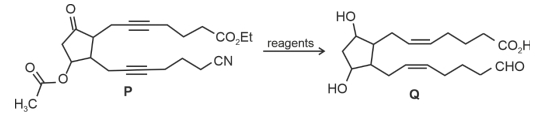
Assertion $(A)$ and the other is labeled as Reason $(R)$. Assertion $(A)$: $\mathrm{CH}_2=\mathrm{CH}-\mathrm{CH}_2-\mathrm{Cl}$ is an example of allyl halide
Reason$(R)$: Allyl halides are the compounds in which the halogen atom is attached to $\mathrm{sp}^2$ hybridised carbon atom.
In the light of the two above statements, choose the $most \ appropriate$ answer from the options given below: