MCQ
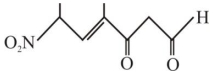
The correct $IUPAC$ name of the following compound is .... .
  • A
    $4-$methyl$-2-$nitro$-5-$oxohept$-3-$enal
  • B
    $4-$methyl$-5-$oxo$-2-$nitrohept$-3-$enal
  • $4-$methyl$-6-$nitro$-3-$oxohept$-4-$enal
  • D
    $6-$formyl$-4-$methyl$-2-$nitrohex$-3-$enal
Answer

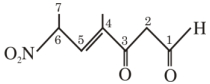
Correct option: C.
$4-$methyl$-6-$nitro$-3-$oxohept$-4-$enal
c
$4-$methyl$-6-$nitro$-3-$oxohept$-4-$enal

Need a full question paper?

Generate a complete, print-ready paper with questions like this in minutes — across 16+ boards, with answer keys.

Start Generating Free

Similar questions

Which of the following compound is optically active?
Match List $I$ with List $II$ :

LIST $I$

(Compound /

Species)

LIST $II$

(Shape / Geometry)

$A$ $\mathrm{SF}_4$ $I$ Tetrahedral
$B$ $\mathrm{BrF}_3$ $II$ Pyramidal
$C$ $\mathrm{BrO}_3^{-}$ $III$ See saw
$D$ $\mathrm{NH}_4^{+}$ $IV$ Bent $T$-shape

Choose the correct answer from the options given below :

In Lassaigne's test of nitrogen the reason behind blue colour is :
The $IUPAC$ name of the compound having the formula is

$\begin{matrix}
   C{{H}_{3}}\,\,\,\,\,\,\,  \\
   |\,\,\,\,\,\,\,\,\,\,\,\,\,\,\,\,  \\
   {{H}_{3}}C-C-CH=C{{H}_{2}}  \\
   |\,\,\,\,\,\,\,\,\,\,\,\,\,\,\,\,\,  \\
   C{{H}_{3}}\,\,\,\,\,\,\,\,\,  \\
\end{matrix}$
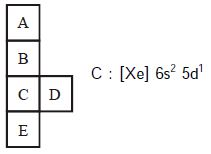
In Mendeleev table, the triad of VIII group is:
The shortest wavelength of $H$ atom is the Lyman series is $\lambda_{1}$. The longest wavelength in the Balmer series of $He ^{+}$ is :
The formation of the oxide ion, O2- (g), from oxygen atom requires first an exothermic and then an endothermic step as shown below:
$\text{O(g)}+\text{e}^-\xrightarrow{\ \ \ \ \ \ \ \ \ \ \ }\text{O}^-(\text{g}),\ \Delta\text{H}^\ominus=-141\text{kJ}\text{ mol}^{-1}$
$\text{O(g)}+\text{e}^-\xrightarrow{\ \ \ \ \ \ \ \ \ \ \ }\text{O}^{-2}(\text{g}),\ \Delta\text{H}^\ominus=+780\text{kJ}\text{ mol}^{-1}$
Thus process of formation of O2- in gas phase is unfavourable even though O2- is isoelectronic with neon. It is due to the fact that:
Which of the following attain the linear structure?
Then choose the correct option
The number of ions present in $2\,L$ of a solution of $1.6\, M\, K_4[Fe(CN)_6]$ is