MCQ
The correct order for $E_2$ reaction with alc. $KOH$ will be
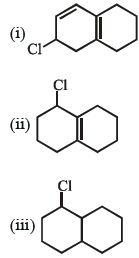
  • $i > ii > iii$
  • B
    $iii > ii > i$
  • C
    $ii > i > iii$
  • D
    $iii > i > ii$

Answer

Correct option: A.
$i > ii > iii$
a

Need a full question paper?

Generate a complete, print-ready paper with questions like this in minutes — across 16+ boards, with answer keys.

Start Generating Free

Similar questions

Reaction of thionyl chloride with white phosphorus forms a compound $[ A ]$, which on hydrolysis gives $[B]$, a dibasic acid.$[A]$ and $[B]$ are respectively
Olefins can be hydrogenated by
Which of the following reactions is not exothermic
Zinc and mercury do not show variable valency like $d-$ block elements because
Among the bonds formed by a chlorine atom with atoms of hydrogen, chlorine, sodium and carbon, the strongest bond is formed between
For a reaction if ${K_p} > {K_c}$, the forward reaction is favoured by
For a reaction $A \xrightarrow{ K _1} B \xrightarrow{ K _2} C$ If the rate of formation of $B$ is set to be zero then the concentration of $B$ is given by :
Given below are two statements :
Statement I : Wet cotton clothes made of cellulose based carbohydrate takes comparatively longer time to get dried than wet nylon polymer based clothes.
Statement II : Intermolecular hydrogen bonding with water molecule is more in nylon-based clothes than in the case of cotton clothes.
In the light of above statements, choose the Correct answer from the options given below
$A$ $\xrightarrow{{KOBr}}$ $CHBr_3$

Here $A$ is nothing but :

The reactions of $Cl _2$ gas with cold-dilute and hot-concentrated $NaOH$ in water give sodium salts to two (different) oxoacids of chlorine, $P$ and $Q$, respectively. The $Cl _2$ gas reacts with $SO _2$ gas, in presence of charcoal, to give a product $R$. $R$ reacts with white phosphours to give a compound $S$. On hydrolysis, $S$ gives an oxoacid of phosphours $T$

$1.$ $P$ and $Q$, respectively, are the sodium salts of

$(A)$ hypochlorus and chloric acids

$(B)$ hypochlorus and chlorus acids

$(C)$ chloric and perchloric acids

$(D)$ chloric and hypochlorus acids

$2.$ $R , S$ and $T$, respectively, are

$(A)$ $SO _2 Cl _2, PCl _5$ and $H _3 PO _4$

$(B)$ $SO _2 Cl _2, PCl _3$ and $H _3 PO _3$

$(C)$ $SOCl _2, PCl _3$ and $H _3 PO _2$

$(D)$ $SOCl _2, PCl _5$ and $H _3 PO _4$

Give the answer question $1$ and $2.$