MCQ
The correct order of atomic/ionic radii is
  • $Sc >T i > V > C r$
  • B
    $Co > Ni > Cu > Zn$
  • C
    $S^{2-}>Cl^->O^{2-}>N^{3-}$
  • D
    None of these

Answer

Correct option: A.
$Sc >T i > V > C r$
a
$(a)\,\, (a)\, Sc > Ti > V > Cr$ (size decrease initially in $3d-$ series)
          $(b) $ Correct order : $Zn > Cu > CO \approx Ni$
          $(c)$ Correct order : $S^{2-} > Cl^{-} > N^{3-} > O^{2-}$

Need a full question paper?

Generate a complete, print-ready paper with questions like this in minutes — across 16+ boards, with answer keys.

Start Generating Free

Similar questions

Molar conductances of $BaCl_2, H_2SO_4$ and $HCl$ at infinite dilutions are $x_1, x_2$  and $x_3$, respectively. Equivalent conductance of $BaSO_4$ at infinite dilution  will be
The $IUPAC$ name of $\begin{matrix}
   O\,\,\,\,\,\,\,\,\,\,\,\,\,\,\,\,\,\,\,\,\,\,\,\,\,\,\,\,\,\,  \\
   ||\,\,\,\,\,\,\,\,\,\,\,\,\,\,\,\,\,\,\,\,\,\,\,\,\,\,\,\,\,\,  \\
   C{{H}_{3}}-C-CH-CH-C{{H}_{3}}  \\
   \,\,\,\,\,\,|\,\,\,\,\,\,\,\,\,\,\,\,\,|  \\
   \,\,\,\,\,\,\,\,\,\,\,{{C}_{2}}{{H}_{5}}\,\,\,C{{H}_{3}}  \\
\end{matrix}$ is
The period number and group number of ''Tantalum" $(Z = 73)$ are respectively
Among the following statements, the correct statement about the half-life period for a first order reaction is
which of the following is product $"A"$ in the.above reaction?
Wilkinson catalyst is
At $20^{\circ} \mathrm{C}$, the vapour pressure of benzene is $70 \,torr$ and that of methyl benzene is $20\, torr.$ The mole fraction of benzene in the vapor phase at $20^{\circ} \mathrm{C}$ above an equimolar mixture of benzene and methyl benzene is $.....\,\times 10^{-2}$ (Nearest integer)
The electronic configuration of three elements $A,B$ and $C$ are given below. Stable form of $C$ may be represented by the formula

$A : 1s^2\, 2s^2\, 2p^6$

$B : 1s^2\, 2s^2\, 2p^6\, 3s^2\, 3p^3$

$C : 1s^2\, 2s^2\, 2p^6\, 3s^2\, 3p^5$

In the given reaction :

$C{H_3} - C{H_2} - \mathop S\limits_{ \bullet \,\, \bullet }^{ \bullet \,\, \bullet }  - \mathop C\limits^* {H_2} - C{H_2} - Br\xrightarrow{{HOH}}[X]$

$[X]$ will be :
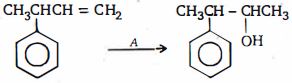
Reagent $A$ may be