MCQ
The correct order of basic strength.
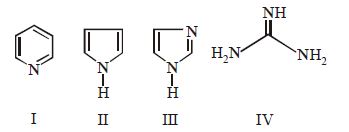
  • A
    $IV>I>II>III$
  • B
    $IV > I > III > II$
  • C
    $III > IV > I > II$
  • $IV > III > I > II$

Answer

Correct option: D.
$IV > III > I > II$
d

Need a full question paper?

Generate a complete, print-ready paper with questions like this in minutes — across 16+ boards, with answer keys.

Start Generating Free

Similar questions

In the following acid-base reaction, in which can backward reaction if favoured?
The formation of the oxide ion $O^{-2}_{(g)}$ requires first an exothermic and then an endothermic step as shown below 

$O(g) + e^- = O^-(g)$      $\Delta {H_{eg}} =  - 142\,kJ\,mo{l^{ - 1}}$
$O^-(g) + e^- = O^{2-}(g)$    $\Delta {H_{eg}} =  +844\,kJ\,mo{l^{ - 1}}$

This is because

Given below are two statements:

Statement $I : C _{2} H _{5} OH$ and $AgCN$ both can generate nucleophile.

Statement $II : KCN$ and $AgCN$ both will generate nitrile nucleophile with all reaction conditions.

Choose the most appropriate option :

A hard and resistant metal (alloy) generally used in tip of nib of fountain pen is
If enthalpy of atomisation for $\mathrm{Br}_{2(l)}$ is $\mathrm{x}\; \mathrm{kJ} / \mathrm{mol}$ and bond enthalpy for $\mathrm{Br}_{2}$ is $y \;\mathrm{kJ} / \mathrm{mol}$, the relation between them
$100\, \mathrm{~mL}$ of $\mathrm{Na}_{3} \mathrm{PO}_{4}$ solution contains $3.45\, \mathrm{~g}$ of sodium. The molarity of the solution is $.....\times 10^{-2}$ $\operatorname{mol} \,\mathrm{L}^{-1} \cdot($ Nearest integer $)$

[Atomic Masses - $\mathrm{Na}: 23.0\, \mathrm{u}, \mathrm{O}: 16.0\, \mathrm{u}, \mathrm{P}: 31.0 \,\mathrm{u}]$

The interaction between $\pi$ bond and lone pair of electrons present on an adjacent atom is responsible for
The first four ionisation energy values of an element are $191, 578, 872$ and $5962\,kcal$.The number of valence electron in the element is :-
First ionization energy is the lowest with
The volumes of $4\,N\,\,HCl$ and $10\,N\,\,HCl$ required to make $ 1\,litre$ of $6\,N\,\,HCl$ are