MCQ
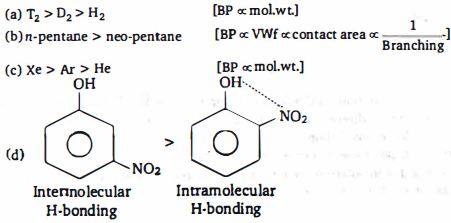
The correct order of boiling point is
  • A
    $T_2 < D_2 < H_2$
  • $n -$ pentane $<$ neo-pentane
  • C
    $Xe < Ar < He$
  • D
    $m -$ nitrophenol $>$ $o -$ nitrophenol
Answer

Correct option: B.
$n -$ pentane $<$ neo-pentane
b

Need a full question paper?

Generate a complete, print-ready paper with questions like this in minutes — across 16+ boards, with answer keys.

Start Generating Free

Similar questions

$C{H_3}CHO + \mathop {HCHO}\limits_{(excess)} \,\xrightarrow{{Conc.\,NaOH}}\,product.$  

Product is :-

$2MnO_4^ - + 5{H_2}{O_2} + 6{H^ + } \to 2\,\,Z + 5{O_2} + 8{H_2}O$. In this reaction $Z $ is
$CsOH + HCl \to  CsCl + H_2O, \Delta H = -13.4\, K\, cal/mol, CsOH + HA \to$  $CsA + H_2O$ , $\Delta H=  -10.4\, K\, cal/mol$ Then calculate $'\Delta H'$ ionisation of $HA$......$K\, cal$
Borazine, also known as inorganic benzene, can be prepared by the reaction of $3-equivalents$ of " $X$ " with $6-equivalents$ of "$Y$"."$X$" and "$Y$", respectively are.
Number of compounds with one lone pair of electrons on central atom amongst following is__________ $\mathrm{O}_3, \mathrm{H}_2 \mathrm{O}, \mathrm{SF}_4, \mathrm{ClF}_3, \mathrm{NH}_3, \mathrm{BrF}_5, \mathrm{XeF}_4$
Which of the following compound of sulphur doesn't hydrolysed at room temperature ?
A sample was weighted using two different balances. The result’s were (i) $3.929\, g$ (ii) $4.0\, g$. How would the weight of the sample be reported......$g$
Aluminium chloride in acidified aqueous solution forms an ion having geometry
The depression in freezing point observed for a formic acid solution of concentration $0.5\,mL\,L ^{-1}$ is $0.0405^{\circ}\,C$. Density of formic acid is $1.05\,g\,mL ^{-1}$. The Van't Hoff factor of the formic acid solution is nearly: (Given for water $k _{ f }=1.86\,K\,kg\,mol ^{-1}$ )
$10.0 \,\mathrm{~mL}$ of $0.05\, \mathrm{M}\, \mathrm{KMnO}_{4}$ solution was consumed in a titration with $10.0\, \mathrm{~mL}$ of given oxalic acid dihydrate solution. The strength of given oxalic acid solution is $.....\,\times 10^{-2} \,\mathrm{~g} / \mathrm{L}$ (Round off to the nearest integer)