MCQ
The correct order of metallic character is:
  • A
    $Be > Ca > K$
  • B
    $Ca > K > Be$
  • $K > Ca > Be$
  • D
    $K > Be > Ca$

Answer

Correct option: C.
$K > Ca > Be$
c
On moving from top to bottom metallic character increases while on moving from left to right metallic decreases.

$K > Ca > Be$

Need a full question paper?

Generate a complete, print-ready paper with questions like this in minutes — across 16+ boards, with answer keys.
Start Generating Free

Similar questions

The reaction for which ${K_c} \leq {K_p}$ at $298\ K$
Which of the following is not used to distinguish ethene from ethane
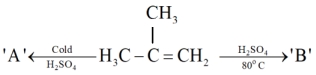
The major products ' $A$ ' and ' $B$ ', respectively, are
$60 \,g$ of a compound on analysis gave $C = 24\,{\rm{ }}g,$ $H = 4\,{\rm{ }}g$ and $O = 32\, g$. Its Empirical formula is
Given below are two statements:

Statement $I$: Tropolone is an aromatic compound and has $8 \pi$ electrons.

Statement $II$: $\pi$ electrons of $ > C = O$ group in tropolone is involved in aromaticity.

In the light of the above statements, choose the correct answer from the options given below:

If the solubility of a sparingly soluble salt of the type $B{A_2}$ (giving three ions on dissociation of a molecule) is $x$ moles per litre, then its solubility product is given by
Calculate $\Delta H \,(kJ/mole)$ for the reaction :-
$2FeO_{(s)} + \frac{1}{2}\, O_{2(g)} \to Fe_2O_{3(g)}$

Given                                                                                                   $\Delta H$

$(i)\, Fe_2O_{3(s)}+3C_{(graphite)} \to 2Fe_{(s)} + 3CO_{(g)}$         $492\, kJ/mol$

$(ii)\, FeO_{(s)}+C_{(graphite)} \to Fe_{(s)} + CO_{(g)}$                     $156\, kJ/mol$

$(iii)\, C_{(graphite)} + O_{2(g)} \to CO_{2(g)}$                                   $-393 \,kJ/mol$

$(iv)\, CO_{(g)} + \frac{1}{2}\, O_{2(g)} \to CO_{2(g)}$                            $-283\, kJ/mol$

For the following two acid-base reactions, which statement is True ?

$(I){\mkern 1mu} C{H_3}CH_2^ - {\mkern 1mu}  + {\mkern 1mu} \mathop {C{H_3}N{H_2}}\limits_{p{K_a} = 35}  \rightleftharpoons \mathop {C{H_3}C{H_3}}\limits_{p{K_a} = 50}  + C{H_3}N{H^ - }$

$(II){\mkern 1mu} {F^ - }{\mkern 1mu}  + {\mkern 1mu} \mathop {{H_2}O}\limits_{p{K_a} = 15.7}  \rightleftharpoons \mathop {HF}\limits_{p{K_a} = 3.2}  + H{O^ - }$

Methyl group attached to benzene can be oxidised to carboxyl group by reacting with
Which of the following is observed in ethylene molecule