MCQ
The correct reactivity order for $E_2$ reaction with alcoholic $KOH$ will be
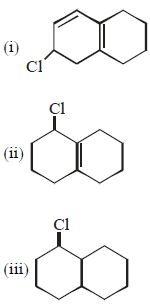
  • $i > ii > iii$
  • B
    $ii > iii > i$
  • C
    $i > iii > ii$
  • D
    $iii > i > ii$

Answer

Correct option: A.
$i > ii > iii$
a
More stable alkene will be major product

Need a full question paper?

Generate a complete, print-ready paper with questions like this in minutes — across 16+ boards, with answer keys.
Start Generating Free

Similar questions

Which of the following does not exhibit paramagnetic characteristics? (Atomic numbers $Ti =22 ; Fe =26$; $Cr =24 ; Cu =29$ )
Alkyl halides can be obtained by all methods except
Compound $I$ is heated with Conc. HI to give a hydroxy compound $A$ which is further heated with Zn dust to give compound $B$. Identify $A$ and $B$.
The correct order of ligands for writing the formula of complex compounds is _________.
The standard reduction potential for $F{e^{2 + }}/Fe$ and $S{n^{2 + }}/Sn$ electrodes are $ - 0.44$ and $ - 0.14$ volt respectively. For the given cell reaction $F{e^{2 + }} + Sn\, \to Fe + S{n^{2 + }}$, the standard EMF is ...............$\mathrm{V}$
Which of the following does not give Claisen condensation reaction :-
Match the interhalogen compounds of  $column-I$ with the geometry in $column-II$ and assign the correct code.
Column $I$      Column $II$
$(A) \,XX '$ $(i)$ $T-$shape
$(B)\,XX'_3$ $(ii)$ Pentagonal bipyramidal
$(C)\,XX '_5$ $(iii)$ Linear
$(D)\,XX '_7$ $(iv)$ Square pyramidal
  $(v)$ Tetrahedral
Assertion : In rate law, unlike in the expression for equilibrium constants, the exponents for concentrations do not necessarily match the stoichiometric coefficients.

Reason : It is the mechanism and not the balanced chemical equation for the overall change that governs the reaction rate.

Given below are two statements :

Statement $I :$ The esterification of carboxylic acid with an alcohol is a nucleophilic acyl substitution.

Statement $II :$ Electron withdrawing groups in the carboxylic acid will increase the rate of esterification reaction.

Choose the most appropriate option

In the dehydrohalogenation of ethyl chloride, which of the following change occurs?