MCQ
The correct relation between $\gamma=\frac{ C _p}{ c _v}$ and temperature $T$ is :
  • A
    $\gamma \propto \frac{1}{\sqrt{ T }}$
  • $\gamma \propto T ^{\circ}$
  • C
    $\gamma \propto \frac{1}{T}$
  • D
    $\gamma \propto T$

Answer

Correct option: B.
$\gamma \propto T ^{\circ}$
b
$\gamma$ is independent of temperature

Need a full question paper?

Generate a complete, print-ready paper with questions like this in minutes — across 16+ boards, with answer keys.
Start Generating Free

Similar questions

Two waves of intensity ratio $1: 9$ cross each other at a point. The resultant intensities at the point, when $I_1(a)$ Waves are incoherent is $I_1(b)$ Waves are coherent is $I_2$ and differ in phase by $60^{\circ}$. If $\frac{I_1}{I_2}=\frac{10}{x}$ than $x$ =. . . . . . . . . . .
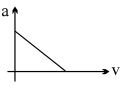
Acceleration versus velocity graph of a particle moving in a straight line starting from rest is as shown in figure. The corresponding velocity-time graph would be
A particle is projected from the ground with velocity $u$ at angle $\theta$ with horizontal. The horizontal range, maximum height and time of flight are $R, H$ and $T$ respectively. They are given by $R = \frac{{{u^2}\sin 2\theta }}{g}$, $H = \frac{{{u^2}{{\sin }^2}\theta }}{{2g}}$ and $T = \frac{{2u\sin \theta }}{g}$  Now keeping $u $ as fixed, $\theta$ is varied from $30^o$ to $60^o$. Then,
Which one of the following physical quantities is not a fundamental quantity?
A particle of mass $m$ collides with a heavy mass (at rest) elastically and after collision returns with $4/9$ of it's initial kinetic energy. The mass of heavy object is ............... $\mathrm{m}$
Consider a photon of a continuous X-ray coming from a Coolidge tube. Its energy comes from:
A source of sound and listener are approaching each other with a speed of $40 m/s.$ The apparent frequency of note produced by the source is $400 \,cps$. Then, its true frequency (in $cps$) is (velocity of sound in air $= 360 m/s$)
An artificial earth satellite of mass $m$ is circling round the earth in an orbit of radius $R$. If the mass of the earth is $M,$ then the total energy of the satellite is:
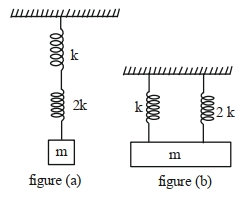
As per given figures, two springs of spring constants $K$ and $2\,K$ are connected to mass $m$. If the period of oscillation in figure $(a)$ is $3 s$, then the period of oscillation in figure $(b)$ will be $\sqrt{ x }$ s. The value of $x$ is$.........$
A lead shot of $1mm$  diameter falls through a long column of glycerine. The variation of its velocity $v$. with distance covered is represented by