MCQ
The correct relation is (Where $B_H=$ Horizontal component of earth's magnetic field; $B_V$ = Vertical component of earth's magnetic field and B = Total intensity of earth's magnetic field)
  • A
    $B=\frac{B_V}{B_H}$
  • B
    $B=B_V\times B_H$
  • $|B| = \sqrt {{B_H}^{2}+{B_v}^{2}}$
  • D
    $B=B_H+B_V$

Answer

Correct option: C.
$|B| = \sqrt {{B_H}^{2}+{B_v}^{2}}$
(c) $|B| = \sqrt {{B_H}^{2}+{B_v}^{2}}$

Need a full question paper?

Generate a complete, print-ready paper with questions like this in minutes — across 16+ boards, with answer keys.

Start Generating Free

Similar questions

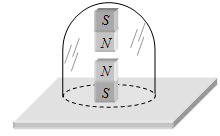
Two identical bar magnets with a length 10 cm and weight 50 gm-weight are arranged freely with their like poles facing in a inverted vertical glass tube. The upper magnet hangs in the air above the lower one so that the distance between the nearest pole of the magnet is 3mm. Pole strength of the poles of each magnet will be
A $800$ turn coil of effective area $0.05\; \mathrm{m}^{2}$ is kept perpendicular to a magnetic fleld $5 \times 10^{-5}\; \mathrm{T}$. When the plane of the coil is rotated by $90^{\circ}$ around any of tis coplanar axis in $0.1\; \mathrm{s}$, the $emf$ induced in the coll will be.....$V$
Watt-hour meter measures
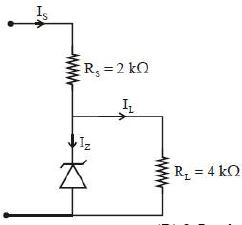
Figure shown a $DC$ voltage regulator circuit, with a Zener diode of breakdown voltage $= 6\,V$. If the unregulated input voltage varies between $10\, V$ to $16\, V$, then what is the maximum Zener current ?.......$mA$
Kinetic energy of an electron accelerated in a potential difference of 100 V is 
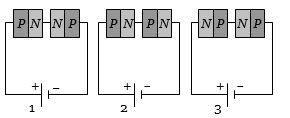
Two $ PN-$junctions can be connected in series by three different methods as shown in the figure. If the potential difference in the junctions is the same, then the correct connections will be
Two non-ideal identical batteries are connected in parallel. Consider the following statements

$(i)$ The equivalent e.m.f. is smaller than either of the two $e.m.f.$ is

$(ii)$ The equivalent internal resistance is smaller than either of the two internal resistances

Energy $E$ of a hydrogen atom with principal quantum number $n$ is given by $E = \frac{{ - 13.6}}{{{n^2}}}\;eV$. The energy of a photon ejected when the electron jumps from $n = 3$ state to $n = 2$ state of hydrogen is approximately......$eV$
Photon and electron are given same energy ($10^{-20} \mathrm{~J}$). Wavelength associated with photon and electron are $\lambda_{\mathrm{ph}}$ and $\lambda_{\mathrm{el}}$ then correct statement will be
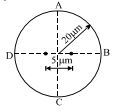
Two point source separated by $d = 5\, \mu m$ emit light of wavelength $\lambda = 2\, \mu m$ in phase.Acircular wire of radius $20\, \mu m$ is placed around the source as shown in figure.