MCQ
The correct stability order for $N_2$ and its given ions is :-
- ✓$N_2 > N_2^+ > N_2^- > N_2^{-2}$
- B$N_2^- > N_2^+ > N_2 > N_2^{-2}$
- C$N_2^+ > N_2^- > N_2 > N_2^{-2}$
- D$N_2 > N_2^+ = N_2^- > N_2^{-2}$
Bond order $=1 / 2 \times\left(\mathrm{N}_{\mathrm{B}}-\mathrm{N}_{\mathrm{AB}}\right)$
Order of filling MO is:
1. $\mathrm{N}_{2}$ :
valence electrons $=5+5=10$
$(\sigma 2 \mathrm{s})^{2}(\sigma * 2 \mathrm{s})^{2}(\sigma 2 \mathrm{p})^{2}(\pi 2 \mathrm{p})^{4}$
$\mathrm{BO}=1 / 2 \times(6-0)=3$
2. $\mathrm{N}_{2}^{+}$
valence electrons $=5+5-1=9$
$(\sigma 2 \mathrm{s})^{2}(\sigma * 2 \mathrm{s})^{2}(\sigma 2 \mathrm{p})^{2}(\pi 2 \mathrm{p})^{3}$
$\mathrm{BO}=1 / 2 \times(5-0)=2.5$
$3 . \mathrm{N}_{2}^{-}$
valence electrons $=5+5+1=11$
$(\sigma 2 s)^{2}(\sigma * 2 s)^{2}(\sigma 2 p)^{2}(\pi 2 p)^{4}\left(\pi^{*} 2 p\right)^{1}$
$\mathrm{BO}=1 / 2 \times(6-1)=2.5$
4. $\mathrm{N}_{2}^{2-}$
valence electrons $=5+5+2=12$
$(\sigma 2 \mathrm{s})^{2}(\sigma * 2 \mathrm{s})^{2}(\sigma 2 \mathrm{p})^{2}(\pi 2 \mathrm{p})^{4}\left(\pi^{*} 2 \mathrm{p}\right)^{2}$
$\mathrm{BO}=1 / 2 \times(6-2)=2$
bond strength or stability: $\mathrm{N}_{2}>\mathrm{N}_{2}^{+}>\mathrm{N}_{2}^{-}>\mathrm{N}_{2}^{2-}$
$\mathrm{N}_{2}^{+}$
here $\mathrm{N}_{2}^{+}$ and $\mathrm{N}_{2}^{-}$ have same bond order but later has one electron in antibonding orbital which reduces its stability as compared to $\mathrm{N}_{2}^{+}$
Therefore, A is correct.
Generate a complete, print-ready paper with questions like this in minutes — across 16+ boards, with answer keys.
(The atomic mass of $Na$ is $23\, g / mol$ ) :
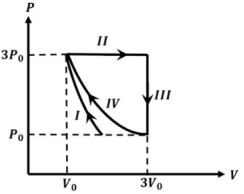
| List-$I$ | List-$II$ |
| $P$ In process $I$ | $1$ Work done by the gas is zero |
| $Q$ In process $II$ | $2$ Temperature of the gas remains unchanged |
| $R$ In process $III$ | $3$ No heat is exchanged between the gas and its surroundings |
| $S$ In process $IV$ | $4$ Work done by the gas is $6 P _0 V _0$ |