MCQ
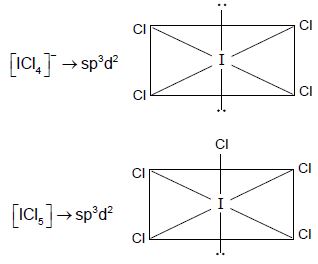
The correct statement about $ICl_5$ and $ICl_4^-$ is
  • A
    $ICl_5$ is trigonal bipyramidal and $ICl_4^-$ is tetrahedral
  • $ICl_5$ is square pyramidal and $ICl_4^-$ is square planar
  • C
    $ICl_5$ is square pyramidal and $ICl_4^-$ is tetrahedral
  • D
    Both are isostructural

Answer

Correct option: B.
$ICl_5$ is square pyramidal and $ICl_4^-$ is square planar
b

Need a full question paper?

Generate a complete, print-ready paper with questions like this in minutes — across 16+ boards, with answer keys.

Start Generating Free

Similar questions

Hess's law of constant heat summation in based on
Highest covalent character is found in
$\Delta\text{S}(\text{A}\rightarrow\text{C})=50\text{ev},$$\Delta\text{S}(\text{C}\rightarrow\text{D})=30\text{ev},$
$\Delta\text{S}(\text{B}\rightarrow\text{D})=20\text{ev}$
$\text{A}\rightarrow\text{B}$
$\downarrow\ \ \ \ \ \uparrow$
$\text{C}\rightarrow\text{D}$
The entropy change for $A \rightarrow B$ would be :
The molar solubility of $\mathrm{Zn}(\mathrm{OH})_{2}$ in $0.1 \,\mathrm{M} \,\mathrm{NaOH}$ solution is $\mathrm{x} \times 10^{-18} \,\mathrm{M}$. The value of $\mathrm{x}$ is ...... . (Nearest integer)

(Given : The solubility product of $\mathrm{Zn}(\mathrm{OH})_{2}$ is $\left.2 \times 10^{-20}\right)$

Reaction of ammonia with diborane gives initially $\mathrm{B}_2 \mathrm{H}_6 \cdot 2 \mathrm{NH}_3$ which on further heating gives:
Which of the following occurs easily in ethylene
The nitrogen atom has an atomic number $7$ and oxygen has an atomic number $8$ Calculate the total number of electrons in nitrate ion.
$2$ moles of $PC{l_5}$ were heated in a closed vessel of $2$ litre capacity. At equilibrium, $40\%$ of $PC{l_5}$ is dissociated into $PC{l_3}$ and $C{l_2}$. The value of equilibrium constant is
Gaseous $N_2O_4$ dissociates into gaseous $NO_2$ according to the reaction

$[{N_2}{O_4}\,(g)\, \rightleftharpoons \,2N{o_2}(g)]$

At $300\,K$ and $1\,atm$ pressure, the degree of dissociation of $N_2O_4$ is $0.2.$ If one mole of $N_2O_4$ gas is contained in a vessel, then the density of the equilibrium mixture is.......$g/L$

For the reaction, $A(g) + B(g) \to  C(g) + D(g),$  $\Delta H^o$ and $\Delta S^o$ are, respectively, $-29.8\,\,kJ\, mol^{-1}$  and $-0.100\,\,kJ\,K^{-1}$ $mol^{-1}$ at  $298\,K.$  The equilibrium constant for the reaction at  $298\,K$  is