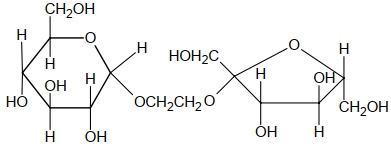
- ✓Ring $(a)$ is pyranonse with $\alpha$-glycosidic link
- BRing $(a)$ is furanonse with $\alpha$-glycosidic link
- CRing $(b)$ is furanonse with $\alpha$-glycosidic link
- DRing $(b)$ is pyranonse with $\beta$ - glycosidic link
The six-membered cyclic structure of glucose is called pyranose structure ( $\alpha$ - or $\beta-$ ), in analogy with pyran which is a cyclic organic compound with one oxygen and five carbon atoms in the ring.
Hence, ring $(i)$ is pyranose.
The ring $(i)$ is pyranose with $\alpha$-glycosidic linkage which means the oxide linkage which connects the monosaccharide units in polysaccharide below the plane.
Generate a complete, print-ready paper with questions like this in minutes — across 16+ boards, with answer keys.
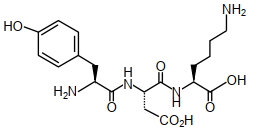
If the absolute values of the net charge of the peptide at $pH =2, pH =6$, and $pH =11$ are $\left| z _1\right|,\left| z _2\right|$ and $\left|z_3\right|$, respectively, then what is $\left|z_1\right|+\left|z_2\right|+\left|z_3\right|$ ?