MCQ
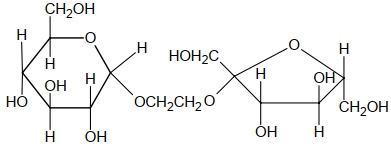
The correct statement about the following disaccharide is
  • Ring $(a)$ is pyranonse with $\alpha$-glycosidic link
  • B
    Ring $(a)$ is furanonse with $\alpha$-glycosidic link
  • C
    Ring $(b)$ is furanonse with $\alpha$-glycosidic link
  • D
    Ring $(b)$ is pyranonse with $\beta$ - glycosidic link

Answer

Correct option: A.
Ring $(a)$ is pyranonse with $\alpha$-glycosidic link
a
$(A)$ ring $(i)$ is pyranose with $\alpha$-glycosidic link

The six-membered cyclic structure of glucose is called pyranose structure ( $\alpha$ - or $\beta-$ ), in analogy with pyran which is a cyclic organic compound with one oxygen and five carbon atoms in the ring.

Hence, ring $(i)$ is pyranose.

The ring $(i)$ is pyranose with $\alpha$-glycosidic linkage which means the oxide linkage which connects the monosaccharide units in polysaccharide below the plane.

Need a full question paper?

Generate a complete, print-ready paper with questions like this in minutes — across 16+ boards, with answer keys.

Start Generating Free

Similar questions

Which alcohol react readily with lucas reagent
Transition metals are often paramagnetic owing to
The inert gas present in the second long period is:
For 'invert sugar', the correct statement(s) is(are)

(Given: specific rotations of ($+$)-sucrose, ($+$)-maltose, $L$-($-$)-glucose anc. $+(+)$-fructose in aqueous solution are $+66^{\circ},+140^{\circ},-52^{\circ}$ and $+92^{\circ}$, respectively)

($A$) 'invert sugar' is prepared by acid catalyzed hydrolysis of maltose

($B$) . 'invert sugar' is an equimolar mixture of $D$-($+$)-glucose and $D$-($-$)-fructose

($C$) specific rotation of 'invert sugar' is $-20^{\circ}$

($D$) on reaction with $\mathrm{Br}_2$ water, 'invert sugar' forms saccharic acid as one of the products
Which one of the following noble gases is not found in the atmosphere
Which of the following is an antacid?
If the boiling points of two solvents $X$ and $Y$ (having same molecular weights) are in the ratio $2 : 1$ and their enthalpy of vaporizations are in the ratio $1: 2$, then the boiling point elevation constant of $X$ is $\underline{ m }$ times the boiling point elevation constant of $Y$. The value of $m$ is $.....$. (Nearest integer)
Number of moles of oxygen that one mole of benzoic acid uses in the production of phenol by oxidative decarboxylation?
Which of the following is the correct order of acidic strength ?
The specific conductivity of $N/10$ $KCl$ solution at ${20\,^o}C$ is $0.0212\,oh{m^{ - 1}}\,c{m^{ - 1}}$ and the resistance of cell containing this solution at ${20\,^o}C$ is $55\,ohm$. The cell constant is ............. $\mathrm{cm}^{-1}$