MCQ
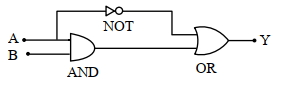
The correct truth table for the following logic circuit is :
  • A
    $A$ $B$ $Y$
    $0$ $0$ $0$
    $0$ $1$ $1$
    $1$ $0$ $0$
    $1$ $1$ $1$
  • $A$ $B$ $Y$
    $0$ $0$ $1$
    $0$ $1$ $1$
    $1$ $0$ $0$
    $1$ $1$ $1$
  • C
    $A$ $B$ $Y$
    $0$ $0$ $1$
    $0$ $1$ $1$
    $1$ $0$ $0$
    $1$ $1$ $1$
  • D
    $A$ $B$ $Y$
    $0$ $0$ $0$
    $0$ $1$ $0$
    $1$ $0$ $0$
    $1$ $1$ $1$

Answer

Correct option: B.
$A$ $B$ $Y$
$0$ $0$ $1$
$0$ $1$ $1$
$1$ $0$ $0$
$1$ $1$ $1$
b

Need a full question paper?

Generate a complete, print-ready paper with questions like this in minutes — across 16+ boards, with answer keys.

Start Generating Free

Similar questions

A printed page is pressed by a glass of water. The refractive index of the glass and water is $1.5$ and $1.33$, respectively. If the thickness of the bottom of glass is $1\, cm$ and depth of water is $5\, cm$ , how much the page will appear to be shifted if viewed from the top ?
Three students $S_{1}, S_{2}$ and $S_{3}$ perform an experiment for determining the acceleration due to gravity $(g)$ using a simple pendulum. They use different lengths of pendulum and record time for different number of oscillations. The observations are as shown in the table.

Student No. Length of pendulum $(cm)$ No. of oscillations $(n)$ Total time for oscillations Time period $(s)$
$1.$ $64.0$ $8$ $128.0$ $16.0$
$2.$ $64.0$ $4$ $64.0$ $16.0$
$3.$ $20.0$ $4$ $36.0$ $9.0$

(Least count of length $=0.1 \,{m}$, least count for time $=0.1\, {s}$ )

If $E_{1}, E_{2}$ and $E_{3}$ are the percentage errors in $'g'$ for students $1,2$ and $3$ respectively, then the minimum percentage error is obtained by student no. ....... .

Given below are two statements: 
Statement $I:$ Electromagnetic waves carry energy as they travel through space and this energy is equally shared by the electric and magnetic fields. 
Statement $II:$ When electromagnetic waves strike a surface, a pressure is exerted on the surface.
 In the light of the above statements, choose the most appropriate answer from the options given below:
A radioactive element emits $200$ particles per second. After three hours $25$ particles per second are emitted. The half life period of element will be ..........$minntes$
A microwave of wavelength $2.0 \ cm$ falls normally on a slit of width $4.0 \ cm .$ The angular spread of the central maxima of the diffraction pattern obtained on a screen $1.5 m$ away from the slit, will be$:$
$Assertion :$ Perspiration from human body helps in cooling the body.
$Reason :$ A thin layer of water on the skin enhances its emissivity.
A particle executing simple harmonic motion along $Y- $axis has its motion described by the equation $y = A\sin (\omega \,t) + B$. The amplitude of the simple harmonic motion is
$A V$-shaped rigid body has two identical uniform arms. What must be the angle between the two arms, so that when the body is hung from one end the other arm is horizontal?
The balls, having linear momenta $\vec{p}_1=\hat{p} \hat{i}$ and $\vec{p}_2=-p \hat{i}$, undergo a collision in free space. There is no external force acting on the balls. Let $\vec{p}_1^{\prime}$ and $\vec{p}_2^{\prime}$ be their final momenta. The following option$(s)$ is (are) $NOT ALLOWED$ for any non-zero value of $\mathrm{p}, \mathrm{a}_1, \mathrm{a}_2, \mathrm{~b}_1, \mathrm{~b}_2, \mathrm{c}_1$ and $\mathrm{c}_2$.

$(A)$ $ \overrightarrow{\mathrm{p}}_1^{\prime}=\mathrm{a}_1 \hat{\mathrm{i}}+\mathrm{b}_1 \hat{\mathrm{j}}+\mathrm{c}_1 \hat{\mathrm{k}} $

$ \overrightarrow{\mathrm{p}}_2^{\prime}=\mathrm{a}_2 \hat{\mathrm{i}}+\mathrm{b}_2 \hat{\mathrm{j}}$

$(B)$ $ \overrightarrow{\mathrm{p}}_1^{\prime}=\mathrm{c}_1 \hat{\mathrm{k}} $

$ \overrightarrow{\mathrm{p}}_2^{\prime}=\mathrm{c}_2 \hat{\mathrm{k}}$

$(C)$ $ \overrightarrow{\mathrm{p}}_1^{\prime}=\mathrm{a}_1 \hat{\mathrm{i}}+\mathrm{b}_1 \hat{\mathrm{j}}+\mathrm{c}_1 \hat{\mathrm{k}} $

$ \overrightarrow{\mathrm{p}}_2=\mathrm{a}_2 \hat{\mathrm{i}}+\mathrm{b}_2 \hat{\mathrm{j}}-\mathrm{c}_1 \hat{\mathrm{k}}$

$(D)$ $ \vec{p}_1^{\prime}=a_1 \hat{i}+b_1 \hat{j} $

$ \overrightarrow{\mathrm{p}}_2^{\prime}=a_2 \hat{\mathrm{i}}+b_1 \hat{\mathrm{j}}$
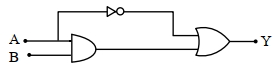
In the given circuit, the terminal potential difference of the cell is :
Image