Question
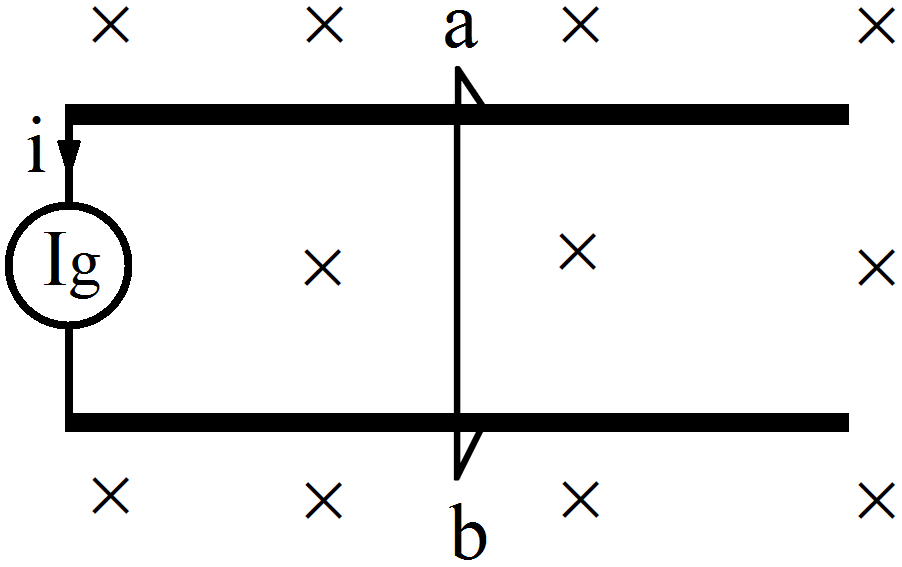
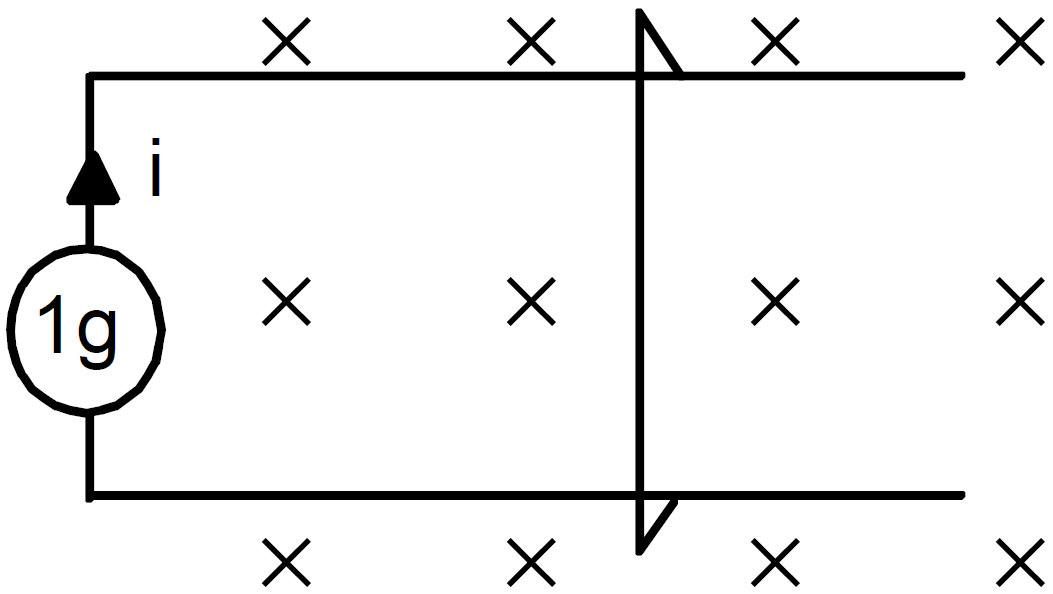
The current generator $I_g$ shown in figure, sends a constant current i through the circuit. The wire ab has a length l and mass m and can slide on the smooth, horizontal rails connected to $I_g$. The entire system lies in a vertical magnetic field $B$. Find the velocity of the wire as a function of time.
Answer


Force on the wire $=\text{ilB}$
Acceleration $=\frac{\text{ilB}}{\text{m}}$
Velocity $=\frac{\text{ilBt}}{\text{m}}$

Need a full question paper?

Generate a complete, print-ready paper with questions like this in minutes — across 16+ boards, with answer keys.

Start Generating Free

Similar questions

A convex lens (n = 1.5) of focal length fa is immersed.
  1. In water n = 1.33 and.
  2. In carbon disulphide n = 1.6, how does the lens behave in the two cases?
Use de$-$ Broglie’s hypothesis to write the relation for the nth radius of Bohr orbit in terms of Bohr’s quantization condition of orbital angular momentum.
Obtain the de Broglie wavelength of a neutron of kinetic energy $150\ eV$. As you have seen in Exercise $11.31,$ an electron beam of this energy is suitable for crystal diffraction experiments. Would a neutron beam of the same energy be equally suitable? Explain. $(m_n = 1.675 \times 10^{–27} \ kg).$
Figure shows a conducting square loop placed parallel to the pole faces of a ring magnet. The Pole$-$faces have an area of $1\ cm^2 $ each and the field between the poles is $0.10T$. The wires making the loop are all outside the magnetic field. If the magnet is removed in $1.0s$, what is the average emf induced in the loop?
Let $\vec{\text{A}}=3\vec{\text{i}}+4\vec{\text{j}}.$ Write four vector $\overrightarrow{\text{B}}$ such that $\overrightarrow{\text{A}}\neq\overrightarrow{\text{B}}$ but A = B.
Estimate the distance for which ray optics is good approximation for an aperture of $4 \ mm$ and wavelength $400 \ nm.$
When are two objects just resolved? Explain. How can the resolving power of a compound microscope be increased? Use relevant formula to support your answer.
Given a uniform electric field $\overrightarrow{\text{E}} = 2 \times 10^3\ \hat{i}\  N/C$ find the flux of this field through a square of side $20 \ cm,$ whose plane is parallel to the $y-z$ plane. What would be the flux through the same square, if the plane makes an angle of $30^{\circ}$ with the$ x-$axis?
In which situation is there a displacement current, but no conduction current?
Write a short note on Ultra violet rays.