Question
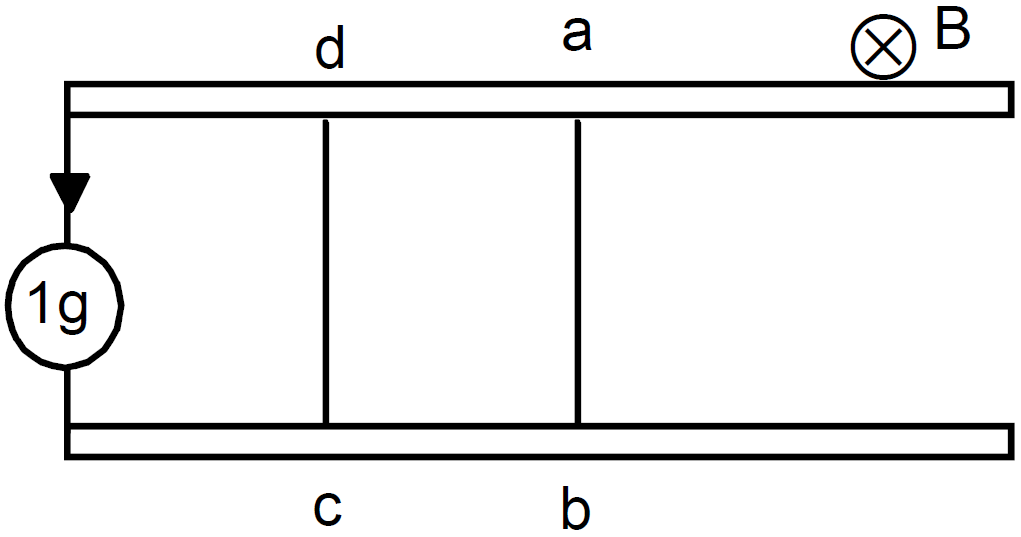
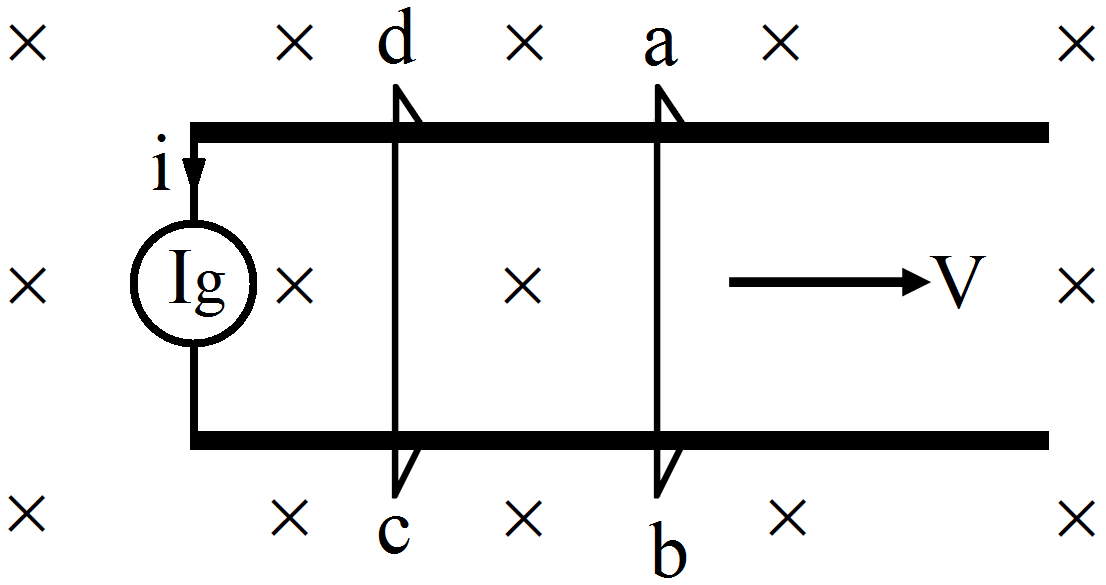
The current generator Ig shown in figure, sends a constant current i through the circuit. The wire cd is fixed and ab is made to slide on the smooth, thick rails with a constant velocity v towards right. Each of these wires has resistance r. Find the current through the wire cd.
Answer


Initial current passing = i

Hence initial emf = ir

Emf due to motion of ab = Blv

Net emf = ir - Blv

Net resistance = 2r

Hence current passing $=\frac{\text{ir}-\text{Blv}}{2\text{r}}$

Need a full question paper?

Generate a complete, print-ready paper with questions like this in minutes — across 16+ boards, with answer keys.

Start Generating Free

Similar questions

On a certain day, speed of sound in air is 350m/s. What is the frequency of fundamental note in a closed pipe of length 0.5m? Also find the frequency of second overtone.
A free atom of iron emits $\text{K}_\alpha$ X-rays of energy 6.4keV. Calculate the recoil kinetic energy of the atom. Mass of an iron atom = 9.3 × 10⁻²⁶kg.
A steel wire of length 4.7m and cross-sectional area 3.0 × 10⁻⁵m2 stretches by the same amount as a copper wire of length 3.5m and cross-sectional area of 4.0 × 10⁻⁵m2 under a given load. What is the ratio of the Young’s modulus of steel to that of copper?
When an apple falls from a tree what happens to its gravitational potential energy just as it reaches the ground? After it strikes the ground?
Can normal force do a nonzero work on an object. If yes, give an example. If no, give reason.
Derive a relation for the time taken by a projectile to reach the highest point and the maximum height attained.
The two wires shown in are made of the,

same material which has a breaking stress of 8 × 10⁸N/m2. The area of cross-section of the upper wire is 0.006cm2 and that of the lower wire is 0.003cm2. The mass m1 = 10kg, m2 = 20kg and the hanger is light:
  1. Find the maximum load that can be put on the hanger without breaking a wire. Which wire will break first if the load is increased?
  2. Repeat the above part if m1 = 10kg and m2 = 36kg.
A projectile is projected with velocity u making an angle $\theta$ with horizontal direction, find:
  1. Time of flight.
  2. Horizontal range.
A source emitting a sound of frequency v is placed at a large distance from an observer. The source starts moving towards the observer with a uniform acceleration a. Find the frequency heard by the observer corresponding to the wave emitted just after the source starts. The speed of sound in the medium is u.