Question
The current in a conductor and the potential difference across its ends are measured by an ammeter and a voltmeter. The meters draw negligible currents. The ammeter is accurate but the voltmeter has a zero error (that is, it does not read zero when no potential difference is applied). Calculate the zero error if the readings for two different conditions are 1.75A, 14.4V and 2.75A, 22.4V.
Answer

Let the voltmeter reading when, the voltage is 0 be X.
$\frac{\text{l}_1\text{R}}{\text{l}_2\text{R}}=\frac{\text{V}_1}{\text{V}_2}$
$\Rightarrow\frac{1.75}{2.75}=\frac{14.4-\text{V}}{22.4-\text{V}}$
$\Rightarrow\frac{0.35}{0.55}=\frac{14.4-\text{V}}{22.4-\text{V}}$
$\Rightarrow\frac{0.07}{0.11}=\frac{14.4-\text{V}}{22.4-\text{V}}$
$\Rightarrow\frac{7}{11}=\frac{14.4-\text{V}}{22.4-\text{V}}$
$\Rightarrow7(22.4-\text{V})=11(14.4-\text{V})$
$\Rightarrow156.8-7\text{V}=158.4-11\text{V}$
$\Rightarrow(7-11)\text{V}=156.8-158.4\Rightarrow-4\text{V}=-1.6$
$\Rightarrow\text{V}=0.4\text{V}.$

Need a full question paper?

Generate a complete, print-ready paper with questions like this in minutes — across 16+ boards, with answer keys.

Start Generating Free

Similar questions

A uniform magnetic field of 1.5 T exists in a cylindrical region of radius10.0 cm, its direction parallel to the axis along east to west. A wire carrying current of 7.0 A in the north to south direction passes through this region. What is the magnitude and direction of the force on the wire if,
  1. The wire intersects the axis,
  2. The wire is turned from N-S to northeast-northwest direction,
  3. The wire in the N-S direction is lowered from the axis by a distance of 6.0 cm?
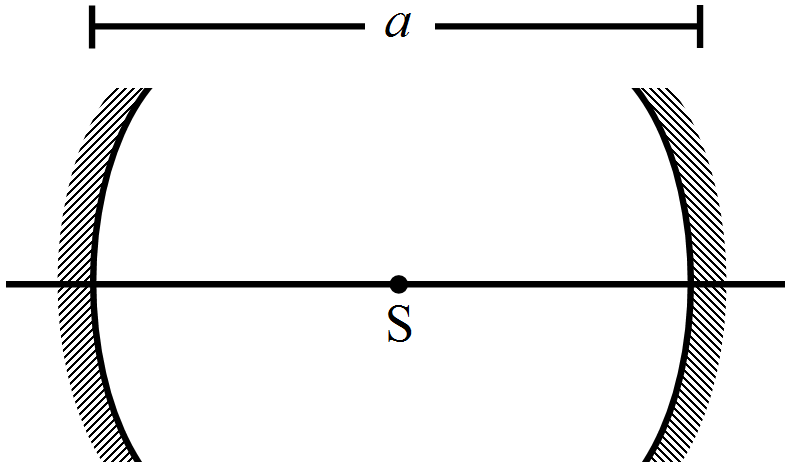
A point source S is placed midway between two converging mirrors having equal focal length f. Find the values of d for which only one image is formed.
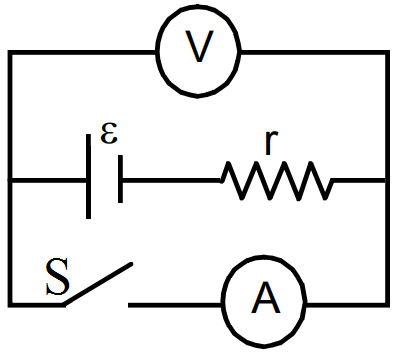
Figure. shows an arrangement to measure the emf $\in$ and internal resistance r of a battery. The voltmeter has a very high resistance and the ammeter also has some resistance. The voltmeter reads 1.52V when the switch S is open. When the switch is closed, the voltmeter reading drops to 1.45V and the ammeter reads 1.0A. Find the emf and the internal resistance of the battery.
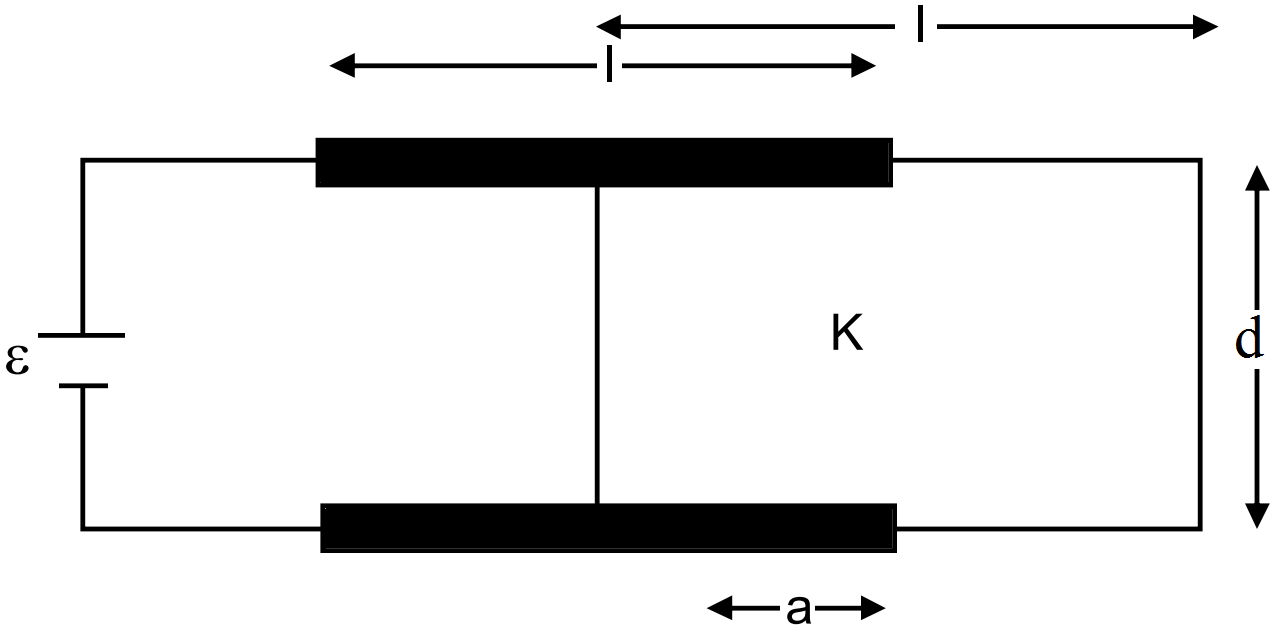
Consider the situation shown in figure. The plates of the capacitor have plate area A and are clamped in the laboratory. The dielectric slab is released from rest with a length a inside the capacitor. Neglecting any effect of friction or gravity, show that the slab will execute periodic motion and find its time period.
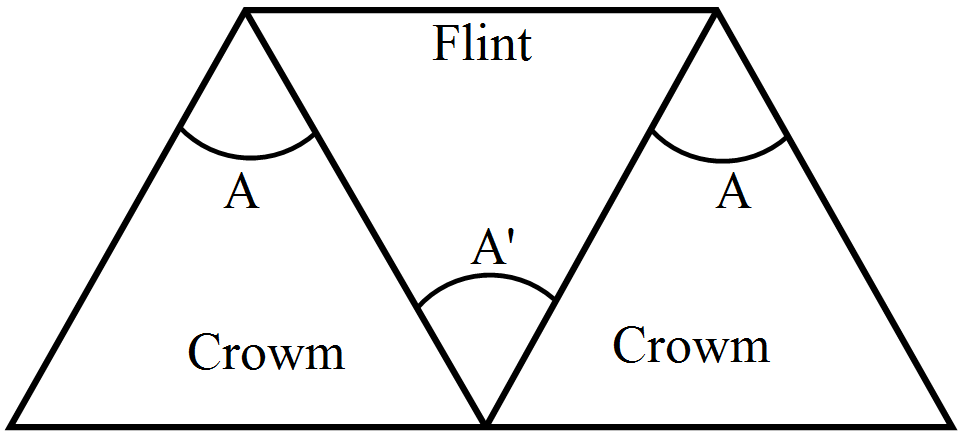
Three thin prisms are combined as shown in figure. The refractive indices of the crown glass for red, yellow and violet rays are $\mu_\text{r},\mu_\text{y}$ and $\mu_\text{v}$ respectively and those for the flint glass are $\mu'_\text{r},\mu'_\text{y}$ and $\mu'_\text{v}$ respectively. Find the ratio $\frac{\text{A}'}{\text{A}}$ for which.
  1. There is no net angular dispersion.
  2. There is no net deviation in the yellow ray.
When a dielectric is placed in an electric field, it gets polarized. The electric field in a polarized material is less than the applied field. When a paramagnetic substance is kept in a magnetic field, the field in the substance is more than the applied field. Explain the reason of this opposite behaviour.
Find the typical de Broglie wavelength associated with a He atom in helium gas at room temperature (27ºC) and 1 atm pressure; and compare it with the mean separation between two atoms under these conditions.
A capacitor of capacitance C is connected to a battery of emf $\in$ at t = 0 through a resistance R. Find the maximum rate at which energy is stored in the capacitor. When does the rate have this maximum value?
An electric dipole of dipole moment $\vec{\text{P}}$ is placed in a uniform electric field $\vec{\text{E}}.$ Write the expression for the torque $\vec\tau$ experienced by the dipole. Identify two pairs of perpendicular vectors in the expression. Show diagrammatically the orientation of the dipole in the field for which the torque is (i) Maximum (ii) Half the maximum value (iii) Zero.
What will be the path difference between two light waves $y_1=a_1 \sin \omega t$ and $y_2=a_2 \cos (\omega t+$ $\phi)$ ?