MCQ
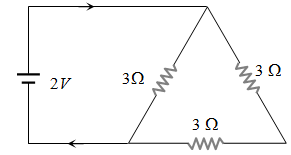
The current in the following circuit is
  • A
    $\frac{1}{8} \mathrm{~A}$
  • B
    $\frac{2}{9} \mathrm{~A}$
  • C
    $\frac{2}{3} \mathrm{~A}$
  • 1A

Answer

Correct option: D.
1A
(d) 1A

Need a full question paper?

Generate a complete, print-ready paper with questions like this in minutes — across 16+ boards, with answer keys.

Start Generating Free

Similar questions

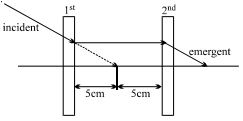
Look at the ray diagram shown, what will be the focal length of the $1^{st}$ and the $2^{nd}$ lens, if the incident light ray passes without any deviation?
In a photoelectric effect experiment a light of frequency $1.5$ times the threshold frequency is made to fall on the surface of photosensitive material. Now if the frequency is halved and intensity is doubled, the number of photo electrons emitted will be:
In a triode amplifier, the value of maximum gain is equal to
When the intensity of light falling on a surface producing photoelectric effect is doubled, then :
The maximum peak to peak voltage of an $AM$ wire is $24 \,mV$ and the minimum peak to peak voltage is $8\, mV$. The modulation factor is.....$\%$
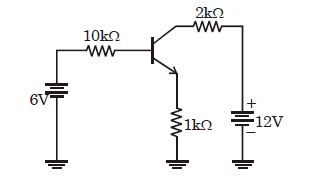
Final value of $I_B$ if ${V_{BE}} = 0.3\,V$ in given circuit $(\beta  = 100)$.........$\mu {\rm A}$
A loop, made of straight edges has four corners at $A (L, L, O)$, $B(-L, L, O)$, $C(-L, -L, O)$, $D(L, -L, O)$. A magnetic field $\vec B = {B_0}\left( {\hat i + \hat k} \right)T$ is present in the region. The magnetic flux passing through the loop $ABCD$ is 
If a linear isotropic dielectric is placed in an electric field of strength $E$, then the polarization $P$ is:
A charged particle with charge $q$ and mass $m$ starts with an initial kinetic energy $K$ at the middle of a uniformly charged spherical region of total charge $Q$ and radius $R$ . $q$ and $Q$ have opposite signs. The spherically charged region is not free to move . The value of $K_0$ is such that the particle will just reach the boundary of the spherically charged region. How much time does it take for the particle to reach the boundary of the region.
A hollow double concave lens is made of very thin transparent material. It can be filled with air or either of two liquids $L_1$ and $L_2$ having refractive indices $n_1$ and $n_2$ respectively ($n_2>n_1>1$). The lens will diverge a parallel beam of light if it is filled with