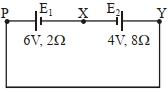
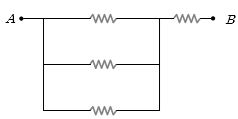
The current in the given circuit is ............ $A$
AIPMT 1999, Medium
Download our app for free and get started
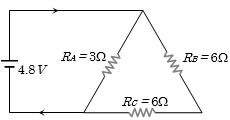
$6$ $\Omega$ and $6\,\Omega$ are in series,
so effective resistance is $12$ $\Omega$
which is in parallel with $3$ $\Omega$,
so $\frac{1}{R} = \frac{1}{3} + \frac{1}{{12}} = \frac{{15}}{{36}}$
$ \Rightarrow $ $R = \frac{{36}}{{15}}$
$I = \frac{V}{R} = \frac{{4.8 \times 15}}{{36}} = 2\,A$

Download our appand get started for free
Experience the future of education. Simply download our apps or reach out to us for more information. Let's shape the future of learning together!No signup needed.*
Similar Questions
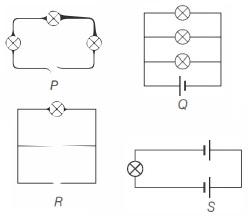
- 1Following figures show different combinations of identical bulb$(s)$ connected to identical battery$(ies)$. Which option is correct regarding the total power dissipated in the circuit?View Solution
- 2Heat produced in a wire of resistance $R$ due to current flowing at constant potential difference is proportional toView Solution
- 3Two batteries of different $e.m.f.'s$ and internal resistance connected in series with each other and with an external load resistor. The current is $3.0 \,A$. When the polarity of one battery is reversed, the current becomes $1.0 \,A$. The ratio of the $e.m.f.'s$ of the two batteries is ............View Solution
- 4A $25\, W$, $ 220\, V$ bulb and a $100\, W$, $220\, V$ bulb are connected in parallel across a $440\, V$ lineView Solution
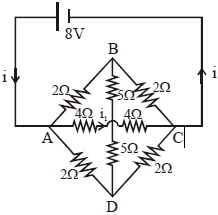
- 5The value of current $i_{1}$ flowing from $A$ to $C$ in the circuit diagram is$.......A$View Solution
- 6A potentiometer wire has length $10\, m$ and resistance $20\,\Omega $. A $2. 5\, V$ battery of negligible internal resistance is connected across the wire with an $80\,\Omega $ series resistance. The potential gradient on the wire will beView Solution
- 7An ammeter with internal resistance $90\,\Omega $ reads $1.85\, A$ when connected in a circuit containing a battery and two resistors $700\,\Omega $ and $410\,\Omega $ in series. Actual current will beView Solution
- 8You are given a resistance wire of length $50\, cm$ and a battery of negligible resistance. In which of the following cases is largest amount of heat generatedView Solution
- 9If all the resistors shown have the value $2\, ohm$ each, the equivalent resistance over $AB$ isView Solution
- 10A cell $E _{1}$ of $emf 6 V$ and internal resistance $2 \Omega$ is connected with another cell $E _{2}$ of $emf 4 V$ and internal resistance $8 \Omega$ (as shown in the figure). The potential difference across points $X$ and $Y$ is............ $V$View Solution