MCQ
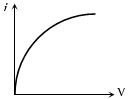
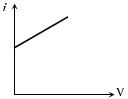
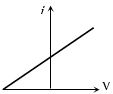
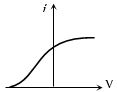
The curve between current $(i)$ and potential difference $(V)$ for a photo cell will be
  • A

  • B

  • C


Answer

Correct option: D.

d
(d) In photocell, at a particular negative potential (stopping potential $V_0$) of anode, photoelectric current is zero,

At the potential difference between cathode and anode increases current through the circuit increases but after some time constant current (saturation current) flows through the circuit even if potential difference still increasing.

Need a full question paper?

Generate a complete, print-ready paper with questions like this in minutes — across 16+ boards, with answer keys.

Start Generating Free

Similar questions

Two identical moving coil galvanometer have $10 \Omega$ resistance and full scale deflection at $2 \mu A$ current. One of them is converted into a voltmeter of $100 mV$ full scale reading and the other into an Ammeter of $1 mA$ full scale current using appropriate resistors. These are then used to measure the voltage and current in the Ohm's law experiment with $R =1000 \Omega$ resistor by using an ideal cell. Which of the following statement( $s$ ) is/are correct?

$(1)$ The measured value of $R$ will be $978 \Omega$

$(2)$ The resistance of the Voltmeter will be $100 k \Omega$.

$(3)$ The resistance of the Ammeter will be $0.02 \Omega$ (round off to $2^{\text {nd }}$ decimal place)

$(4)$ If the ideal cell is replaced by a cell having internal resistance of $5 \Omega$ then the measured value of $R$ will be more than $1000 \Omega$.

An unpolarised light beam of intensity $2 I _{0}$ is passed through a polaroid $P$ and then through another polaroid $Q$ which is oriented in such a way that its passing axis makes an angle of $30^{\circ}$ relative to that of $P$. The intensity of the emergent light is.
An astronaut floating freely in space decides to use his flash light as a rocket. He shines a $10$ watt light beam in a fixed direction so that he acquires momentum in the opposite direction. If his mass is $80$ kg, how long must he need to reach a velocity of $1$ $ms^{-1}$
A plane mirror is placed along the $x-$ axis facing negative $y-$ axis. The mirror is fixed. A point object is moving with velocity $3\hat i + 4\hat j$ in front of plane mirror. The relative velocity of image with respect of its object
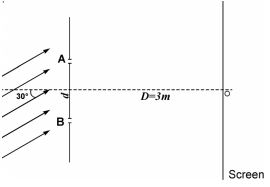
$A$ parallel beam of light $500nm $ is incident at an angle $30^o$ with the normal to the slit plane in a young's double slit experiment. The intensity due to each slit is $Io$. $P$ oint $O$ is equidistant from $S_1$ and $S_2$. The distance between slits is $1mm.$
If the binding energy of the deutrium is $2.23\, MeV$. The mass defect given in $a.m.u.$ is
Each of two large conducting parallel plates has one sided surface area $A$. If one of the plates is given a charge $Q$ whereas the other is neutral, then the electric field at a point in between the plates is given by
If $\lambda_{\alpha u}$ is the wavelength of $K_\alpha X$-ray line of copper (atomic number $29$ ) and $\lambda_{\text {M. }}$ is the wavelength of the $K_\alpha X$-ray line of molybdenum (atomic number $42$ ), then the ratio $\lambda$ is close to
A bulb rated at ($100\,W$ - $200\,V$) is used on a $100\,V$ line. The current in the bulb is
The angle of an equilateral prism is $60^o$. What should be the refractive index of prism so that the ray is parallel to the base inside the prism?