MCQ
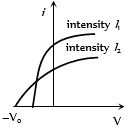
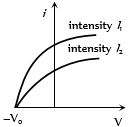
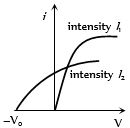
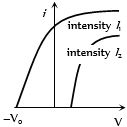
The curves $(a), (b) (c)$ and $ (d)$ show the variation between the applied potential difference $(V)$ and the photoelectric current $(i)$, at two different intensities of light ($I_1$ > $I_2$). In which figure is the correct variation shown
  • A


  • C

  • D

Answer

Correct option: B.

b
(b)${I_1} > {I_2}$ (given)

==> $i_1$ > $i_2$
and stopping potential does not depend upon intensity. So its value will be same $({V_0})$.

Need a full question paper?

Generate a complete, print-ready paper with questions like this in minutes — across 16+ boards, with answer keys.

Start Generating Free

Similar questions

Two coherent sources produce waves of different intensities which interfere. After interference, the ratio of the maximum intensity to the minimum intensity is $16$. The intensity of the waves are in the ratio
The main source of solar energy is
A photon is emitted in transition from $n =4$ to $n =1$ level in hydrogen atom. The corresponding wavelength for this transition is $.........\,nm$ $\text { (given, } h =4 \times 10^{-15} eVs \text { ) : }$
What is the momentum of a photon having frequency $1.5 \times {10^{13}}Hz$
A ray of light falls on the surface of a spherical glass paper weight making an angle α with the normal and is refracted in the medium at an angle β. The angle of deviation of the emergent ray from the direction of the incident ray
Which of the following are true?

$A.$ Speed of light in vacuum is dependent on the direction of propagation.

$B.$ Speed of light in a medium in independent of the wavelength of light.

$C.$ The speed of light is independent of the motion of the source.

$D.$ The speed of light in a medium is independent of intensity.

Choose the correct answer from the option given below :

The source that illuminates the double - slit in 'double - slit interference experiment' emits two distinct monochromatic waves of wavelength $500\,nm$ and $600\, nm$, each of them producing its own pattern on the screen. At the central point of the pattern when path difference is zero, maxima of both the patterns coincide and the resulting interference pattern is most distinct at the region of zero path difference. But as one moves out of this central region, the two fringe systems are gradually out of step such that maximum due to on wavelength coincides with the minimum due to the other and the combined fringe system becomes completely indistinct. This may happen when path difference in $nm$ is
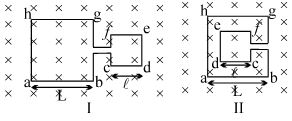
The adjoining figure shows two different arrangements in which two square wire frames are placed in a uniform constantly decreasing magnetic field $B.$ The value of magnetic flux in each case is given by
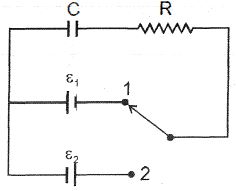
Intially, switch $S$ is connected to position $1$ for a long time shown in figure. The net amount of heat generated in the circuit after it is shifted to position $2$ is 
In Young’s double slit experiment, the wavelength of the light used is doubled and distance between two slits is half of initial distance, the resultant fringe width becomes