Question

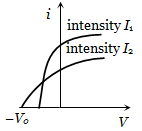
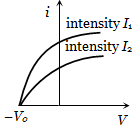
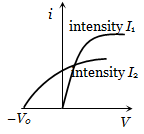
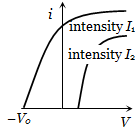
The curves (a), (b) (c) and (d) show the variation between the applied potential difference (V) and the photoelectric current (i), at two different intensities of light (I1 > I2). In which figure is the correct variation shown

 (a)

(b)

(c)

(d)

Answer

(b)

Need a full question paper?

Generate a complete, print-ready paper with questions like this in minutes — across 16+ boards, with answer keys.

Start Generating Free

Similar questions

A wire of resistance 10 W is bent to form a circle. P and Q are points on the circumference of the circle dividing it into a quadrant and are connected to a Battery of 3 V and internal resistance 1 W as shown in the figure.  The currents in the two parts of the circle are

(a)    and

(b)   and

(c)   and

(d)   and

The first line in the Lyman series has wavelength l. The wavelength of the first line in Balmer series is

(a)  

(b)

(c)

(d)

A train is moving towards north with a speed of 180 kilometers per hour. If the vertical component of the earths magnetic filed is 0.2 × 10⁻⁴ T, the emf induced in the axle of length 1.5m is

The heat developed in an electric wire of resistance R by a current I for a time t is

(a)   

(b)

(c)

(d)

Two identical induction coils each of inductance L joined in series are placed very close to each other such that the winding direction of one is exactly opposite to that of the other, what is the net inductance

(a) L2

(b) 2L

(c) L/2

(d) Zero

Current i is carried in a wire of length L. If the wire is turned into a circular coil, the maximum magnitude of torque in a given magnetic field B will be

(a)  

(a)  

(c)  

(d)  

Hydrogen atom excites energy level from fundamental state to n = 3. Number of spectrum lines according to Bohr, is

(a) 4 

(b) 3

(c) 1  

(d) 2

The electrical conductivity of pure germanium can be increased by:
When light is refracted into a medium:
  1. Its wavelength and frequency both increase
  2. Its wavelength increases but frequency remains unchanged
  3. Its wavelength decreases but frequency remains unchanged.
  4. Its wavelength and frequency both decrease.
Which one of the following properties of an element is not variable?