MCQ
The cut-in voltage for silicon diode is approximately.....$V$
  • A
    $0.2$
  • $0.6$
  • C
    $1.1$
  • D
    $1.4$

Answer

Correct option: B.
$0.6$
b
(b)

Need a full question paper?

Generate a complete, print-ready paper with questions like this in minutes — across 16+ boards, with answer keys.
Start Generating Free

Similar questions

The galaxies are moving away from each other. It is explained by
The time dependence of a physical quantity $P$  is given by $P\, = \,{P_0}\,{e^{ - \alpha {t^2}}}$ where $\alpha $ is a constant and $t$ is the time then constant $\alpha $ is
A particle of mass $10\, gm$ is describing $S.H.M.$ along a straight line with period of $2\, sec$ and amplitude of $10, cm$. Its kinetic energy when it is at $5 \,cm$ from its equilibrium position is
A block of ice with mass $m$ falls into a lake. After impact, a mass of ice $m/5$ melts. Both the block of ice and the lake have a temperature of $^o C$. If $L$ represents the heat of fusion, the minimum distance the ice fell before striking the surface is
A very large number of balls are thrown vertically upwards in quick succession in such a way that the next ball is thrown when the previous one is at the maximum height. If the maximum height is $5\,m$, the number of ball thrown per minute is (take $g = 10\,m{s^{ - 2}}$)
$20\%$ of main current passes through the galvanometer. If the resistance of the galvanometer is $G$ , then the resistance of the shunt will be
A fly wheel of moment of inertia $0.4\,\, kg\, m^2$ and radius $0.2\,\, m$ is free to rotate about a central axis. If a string is wrapped around it and it is pulled with a force of $10 \,N$ , then angular velocity after $4\,\, sec$ will be ......... $rad\,\,s^{-1}$.
Assuming that the gravitational potential energy of an object at inflinity is zero, the change in potential energy (final-initial) of an object of mass $\mathrm{m}$, when to a height $h$ from the surface of earth (of radius $\mathrm{R}$ ), is given
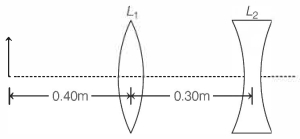
An object is placed $0.40 \,m$ from one of the two lenses $L_1$ and $L_2$ of focal lengths $0.20 \,m$ and $0.10 \,m$ respectively, as depicted in the figure. The separation between the lenses is $0.30 \,m$.The final image formed by these two lenses system is at
A magnetic needle suspended parallel to a magnetic field requires $\sqrt 3\,J$ of work to turn it through $60^o$ . The torque needed to maintain the needle in this position will be.....$J$