MCQ
The decrease in atomic volume from $Cr$ to $Cu$ is very negligible because
  • A
    Increase in nuclear change
  • Screening effect
  • C
    Unpaired electrons of $Cr$
  • D
    None

Answer

Correct option: B.
Screening effect
b
It’s Obvious.

Need a full question paper?

Generate a complete, print-ready paper with questions like this in minutes — across 16+ boards, with answer keys.
Start Generating Free

Similar questions

Liquids $A$ and $B$ form ideal solution over the entire range of composition. At temperature T, equimolar binary solution of liquids $A$ and $B$ has vapour pressure $45$ Torr. At the same temperature, a new solution of $A$ and $B$ having mole fractions $x _{ A }$ and $x _{ B }$, respectively, has vapour pressure of $22.5$ Torr. The value of $x_A / x_B$ in the new solution is . . . . . that the vapour pressure of pure liquid $A$ is $20$ Torr at temperature $T$ )
The value of $K_b$ is given by $mRT_b^2/1000\, X$. In this relation $X$ is :-
The ratio of number of oxygen atoms $(O)$ in $16.0\,g$ ozone $(O_3),\,28.0\,g$ carbon monoxide $(CO)$ and $16.0$ oxygen $(O_2)$ is (Atomic mass $: C = 12, O = 16$ and Avogadro' s constant $N_A = 6.0 \times 10^{23}\,mol^{- 1}$ )
Thermodynamically, the most stable form of carbon is
Which of the following set of quantum numbers belong to highest energy
Which of the following statements is false in relation to enzyme
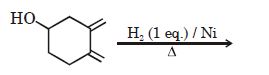
Major product of above reaction is 
For the non-stoichiometric reaction $2A + B \to C + D,$ the following kinetic data were  obtained in three separate experiments, all at $298\,K$.

Initial Conc.
 $(A)$
Initial Conc.
 $(B)$

Initial rate of
formation of $C\,(mol\, L^-S^-)$

$0.1\,M$ $0.1\,M$ $1.2 \times 10^{-3}$
$0.1\,M$ $0.2\,M$ $1.2 \times 10^{-3}$
$0.2\,M$ $0.1\,M$ $2.4 \times 10^{-3}$

For the reaction the rate of formation of $C$ will be

When ethanol mixes in cyclohexane; cyclohexane reduces the intermolecular forces between ethanol molecule. In this, liquid pair shows
The molar solubility $(mol\;{L^{ - 1}})$ of a sparingly soluble salt $M{X_4}$ is $'s'$. The corresponding solubility product is ${K_{sp}}$. $'s'$ is given in terms of $_{{K_{sp}}}$ by the relation