MCQ
The deflection in a moving coil galvanometer is
  • A
    Directly proportional to the torsional constant
  • Directly proportional to the number of turns in the coil
  • C
    Inversely proportional to the area of the coil
  • D
    Inversely proportional to the current flowing
Answer

Correct option: B.
Directly proportional to the number of turns in the coil
(b)$\theta = \frac{{NiAB}}{C} \Rightarrow \theta \propto N$ (Number of turns)

Need a full question paper?

Generate a complete, print-ready paper with questions like this in minutes — across 16+ boards, with answer keys.

Start Generating Free

Similar questions

Hydrogen atom emits blue light when it changes from $n=4$ energy level to the $n=2$ level. Which colour of light would the atom emit when it changes from the $n=5$ level to the $n=2$ level $21.2 \times 10^{-11} m$. What is the principal quantum number $n$ of the final state of the atom
While doing his experiment, Millikan one day observed the following charges on a single drop
(i) $6.563 \times 10^{-19} \mathrm{C}$
(ii) $8.204 \times 10^{-19} \mathrm{C}$
(iii) $11.50 \times 10^{-19} \mathrm{C}$
(iv) $13.13 \times 10^{-19} \mathrm{C}$
(v) $16.48 \times 10^{-19} \mathrm{C}$
(vi) $18.09 \times 10^{-19} \mathrm{C}$
From this data the value of the elementary charge (e)
was found to be
[MP PMT 1993]
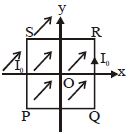
A uniform, constant magnetic field $\vec B$ is directed at an angle of $45^o$ to the $x-$ axis in the $xy-$ plane, $PQRS$ is a rigid square wire frame carrying a steady current $I_0,$ with its centre at the origin $O.$ At time $t = 0,$ the frame is at rest in the position shown in the figure, with its sides parallel to the $x$ and $y$ axis. Each side of the frame is of mass $M$ and Length $L$
A spherical source of power $4 \mathrm{~W}$ and frequency $800 \mathrm{~Hz}$ is emitting sound waves. The intensity of waves at a distance $200 \mathrm{~m}$ is
An object is moving through the liquid. The viscous damping force acting on it is proportional to the velocity. Then dimension of constant of proportionality is
Two spheres made of same substance have diameters in the ratio $1 :2.$ Their thermal capacities are in the ratio of
A particle of mass $m_1$ is moving with a velocity $v_1$ and another particle of mass $m_2$ is moving with a velocity $v_2$. Both of them have the same momentum but their different kinetic energies are $E_1$ and $E_2$ respectively. If $m_1>m_2$ then
Earth is revolving around the sun if the distance of the Earth from the Sun is reduced to $1 / 4$ of the present distance then the present day length reduced by
A $36\  \Omega$ galvanometer is shunted by resistance of $4 \ \Omega$. The percentage of the total current, which passes through the galvanometer is
A ray of light travels from an optically denser to rarer medium. The critical angle for the two media is $C$. The maximum possible deviation of the ray will be