MCQ
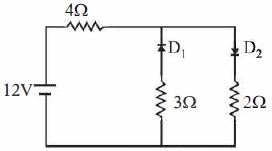
The circuit has two oppositively connected ideal diodes in parallel. What is the current flowing in the circuit?......$A$
  • A
    $1.33$
  • B
    $1.71$
  • $2$
  • D
    $2.31$ 

Answer

Correct option: C.
$2$
c
$D_{2}$ is forward biased whereas $D_{1}$ is reversed biased.

So effective resistance of the circuit $R=4+2=6 \Omega$

$\therefore i=\frac{12}{6}=2 \mathrm{A}$

Need a full question paper?

Generate a complete, print-ready paper with questions like this in minutes — across 16+ boards, with answer keys.
Start Generating Free

Similar questions

Two satellites of masses ${m_1}$ and ${m_2}({m_1} > {m_2})$ are revolving round the earth in circular orbits of radius ${r_1}$ and ${r_2}({r_1} > {r_2})$ respectively. Which of the following statements is true regarding their speeds ${v_1}$ and ${v_2}$ ?
An inductor of inductance $L$ and resistor of resistance $R$ are joined in series and connected by a source of frequency $\omega $. Power dissipated in the circuit is
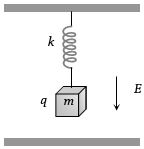
Time period of a block suspended from the upper plate of a parallel plate capacitor by a spring of stiffness $k$ is $T$. When block is uncharged. If a charge $q$ is given to the block them, the new time period of oscillation will be
Laser light $(630\, nm)$ incident on a pair of slits produces an interference pattern in which the bright fringes are separated by $8.3\, mm$. A second light produces an interference pattern in which the bright fringes are separated by $7.6\, mm$. What is the wavelength of this second light.......$nm$
The kinetic energy of an electron which is accelerated through a potential of $100$ volts is
The energy of an $X-$ ray photon of wavelength $1.65 Å$ is.......$keV$ $(h = 6.6 \times {10^{ - 34}}J{\rm{ - }}sec,\,\,c = 3 \times {10^8}m{s^{ - 1}}$, $1eV = 1.6 \times {10^{ - 19}}J)$
The current through a wire depends on time as $i = (2+3t)\, mA$. The charge crossing through a section of the wire in $1\, min$ is .............. $\mathrm{C}$
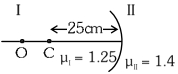
Region $I$ and $II$ are separated by a spherical surface of radius $25\, {cm}$. An object is kept in region $I$ at a distance of $40\, {cm}$ from the surface. The distance of the image from the surface is $.....\,cm$
$A$ particle inside the rough surface of $a$ rotating cone about its axis is at rest relative to it at $a$ height of $1m$ above its vertex. Friction coefficient is $\mu = 0.5$, if half angle of cone is $45^o$, the maximum angular velocity of revolution of cone can be :
A ball is thrown vertically up $($taken as $+z-$ axis$)$ from the ground. The correct momentum-height $(p-h)$ diagram is