Question
“The democracy has been evolved through struggles and movements all over the world.” Support the statements with examples.

Answer

Democracy evolves through popular struggles and movements. When a conflict arises, it may be solved by those groups which are in power and groups which aspire to share power. This leads to the evolution and expansion of democracy in the country. Further, popular struggles and movements play an important role in a democracy. They help in widening democracy. They force the government to recognise and implement laws benefiting wider interests of the society. When a sectional interest group influences the government to make policies in their favour, another group may bring counter pressure on the government, to not make the laws which the first group desires.
This results in maintenance of power balance and accommodation of conflicting interests of the society which ultimately result in the deepening of democracy.
Example: democracy in Nepal has been established because of mass participation of people and the leadership provided by the political leaders. In the United States of America, the Black people had to organise themselves to demand equality in the American society.

Need a full question paper?

Generate a complete, print-ready paper with questions like this in minutes — across 16+ boards, with answer keys.

Start Generating Free

Similar questions

What changes can be seen in the caste system in modern India?
How can democracy accommodate the dignity of women and caste discrimination in one system?
Political parties need to face certain challenges in order to remain effective instruments of democracy. Explain the statement with examples.
Define the role of Gram Sabha in rural local government.
Read the passage below:
Nannu is a daily wage earner. He lives in Welcome Mazdoor Colony, a slum habitation in East Delhi. He lost his ration card and applied for a duplicate one in January 2004. He made several rounds to the local Food & Civil Supplies office for the next three months. But the clerks and officials would not even look at him, leave alone do his job or bother to tell him the status of his application. Ultimately, he filed an application under the Right to Information Act asking for the daily progress made on his application, names of the officials, who were supposed to act on his application and what action would be taken against these officials for their inaction. Within a week of filing application under the Right to Information Act, he was visited by an inspector from the Food Department, who informed him that the card had been made and he could collect it from the office. When Nannu went to collect his card next day, he was given a very warm treatment by the Food & Supply Officer (FSO), who is the head of a Circle. The FSO offered him tea and requested him to withdraw his application under the Right to Information, since his work had already been done.
What does Nannu’s example show? What impact did Nannu’s action have on officials? Ask your parents their experiences when they approach government officials to attend to their problems.
“Poverty and Occupation are directly linked to each other”. Substantiate this statement with four arguments.
What is a legitimate government?
What is the need of the political parties? How would its absence affect any country?###What is the necessity of political parties in a democratic set-up? Explain any four points.
Describe any five major functions of political parties performed in a democracy.
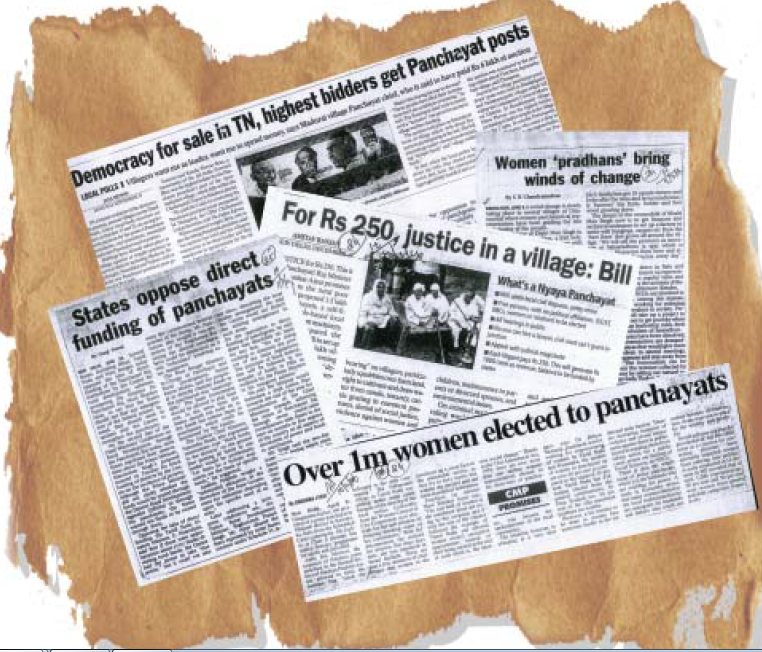
See the following newspaper clippings. What do they want to say about efforts for decentralisation in India?