MCQ
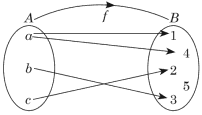
The diagram given below shows that
Image
  • A
    $f$ is a function from $A$ to $B$
  • B
    $f$ is a one-one function from $A$ to $B$
  • C
    $f$ is an onto function from $A$ to $B$
  • $f$ is not a function

Answer

Correct option: D.
$f$ is not a function
(d) : As $f(a)$ is not unique, thus $f$ is not a function.

Need a full question paper?

Generate a complete, print-ready paper with questions like this in minutes — across 16+ boards, with answer keys.

Start Generating Free

Similar questions

If $y = a{x^{n + 1}} + b{x^{ - n}}$, then ${x^2}{{{d^2}y} \over {d{x^2}}} = $
The value of $m$ for which the function $f(x) = \left\{ \begin{array}{l}m{x^2},\,x \le 1\\\,\,\,\,2x,\,x > 1\end{array} \right.$ is differentiable at $x = 1$, is
Let $A=\{1,2,3,5,8,9\}$. Then the number of possible functions $f : A \rightarrow A$ such that $f(m \cdot n)=f(m) \cdot f(n)$ for every $m, n \in A$ with $m \cdot n \in A$ is equal to $...............$.
The angle made by line $\text{r}[\cos\theta−3​\sin\theta]=5 $ with initial line is:
If the shortest distance between the lines $\frac{x-\lambda}{-2}=\frac{y-2}{1}=\frac{z-1}{1}$ and $\frac{x-\sqrt{3}}{1}=\frac{y-1}{-2}=\frac{z-2}{1}$ is $1 ,$ then the sum of all possible values of $\lambda$ is :
The value of $\mathop {Lim}\limits_{n \to \infty } \,\,\sum\limits_{r = 1}^{r = 4n} {\frac{{\sqrt n }}{{\sqrt r {{\left( {\,3\sqrt r  + 4\sqrt n \,} \right)}^2}}}} $ is equal to
If three points A, B and C have position vectors $\hat{\text{i}}+\text{x}\hat{\text{j}}+3\hat{\text{k}},\ 3\hat{\text{i}}+4\hat{\text{j}}+7\hat{\text{k}}$ and $\text{y}\hat{\text{i}}-2\hat{\text{j}}-5\hat{\text{k}}$ respectively are collinear, then (x, y) =
The equation of the line through the point $(0,1,2)$ and perpendicular to the line $\frac{x-1}{2}=\frac{y+1}{3}=\frac{z-1}{-2}$ is
The function $f(x) = {{\log x} \over x}$ is increasing in the interval
Let $f$ and $g$ be continuous functions on $[0, a]$ such that $f(x) = f(a -x)$ and $g(x) + g(a -x) = 4$, then $\int\limits_0^a {f\left( x \right)g\left( x \right)dx} $ is equal to