Question
The dielectric constant k of an insulator cannot be(a) 3 (b) 6(c) 8  (d) ∞   
       

Answer

(d) ∞  

Need a full question paper?

Generate a complete, print-ready paper with questions like this in minutes — across 16+ boards, with answer keys.
Start Generating Free

Similar questions

Identify the wrong statement in the following. Coulomb's law correctly describes the electric force that(a) Binds the electrons of an atom to its nucleus(b) Binds the protons and neutrons in the nucleus of an atom(c) Binds atoms together to form molecules(d) Binds atoms and molecules together to form solids


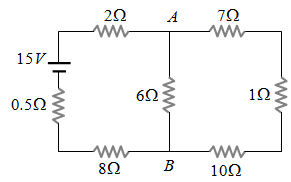
The current from the battery in circuit diagram shown is
There are three resistance coils of equal resistance. The maximum number of resistances you can obtain by connecting them in any manner you choose, being free to use any number of the coils in any way is(a) 3(b) 4(c) 6(d) 5
       
In Young's double slit experiment, the distance between the two slits is $0.1\ mm$ and the wavelength of light used is $4 \times 10^{-7} m$ . If the width of the fringe on the screen is $4\ mm,$ the distance between screen and slit is
The path of a refracted ray of light in a prism is parallel to the base of the prism only when the(a) Light is of a particular wavelength(b) Ray is incident normally at one face(c) Ray undergoes minimum deviation(d) Prism is made of a particular type of glass


In N-type semiconductors, majority charge carriers are(a) Holes(b) Protons(c) Neutrons(d) Electrons
       
When an electric dipole $\overrightarrow{ p }$ is placed in a uniform electric field $\overrightarrow{ E }$ then at what angle between $\overrightarrow{ p }$ and $\overrightarrow{ E }$ the value of torque will be maximum
How can the rate of emission of electrons in a cathode ray tube can be increased?
The accelerations of a particle as seen from two frames $S_1$ and $S_2$ have equal magnitude $4m/s^2.$
  1. The frames must be at rest with respect to each other.
  2. The frames may be moving with respect to each other but neither should be accelerated with respect to the other.
  3. The acceleration of $S_2$with respect to $S_1$ may either be zero or $8m/s^2.$
  4. The acceleration of $S_2$ with respect to $S_1$ may be anything between zero and $8m/s.$
A wavefront is an imaginary surface where: