Question
The difference between the sides at right angle in a right-angled triangle is 7cm. The area of the triangle is $60cm^2$​​​​​​​. Find its perimeter.

Answer

Given:
Area of triangle $= 24cm^2$​​​​​​​
Let the sides be a and b, where a is the height and b is the base of triangle.
a - b = 2cm a - b = 2cm
a = 2 + b ...(1)
Area of triangle $=\frac{1}{2}\times\text{b}\times\text{h}$
$\Rightarrow24=\frac12\times\text{b}\times(2+\text{b})$
$\Rightarrow48=\text{b}+\frac12\text{b}^2$
$\Rightarrow48=2\text{b}+\text{b}^2$
$\Rightarrow\text{b}^2+2\text{b}-48=0$
$\Rightarrow(\text{b}+8)(\text{b}-6)=0$
$\Rightarrow\text{b}=-8$ or 6
Side of a triangle cannot be negative.
Threfore, b = 6cm.
Substituting the value of b = 6cm, in equatin (1) we get:
a = 2 + 6 = 8cm
Now, a = 8cm, b = 6cm
Now, in the given right triangle, we have to find third side.
Using the relation
$(Hyp)^2 = (Oneside)^2 + (Otherside)^2$
$\Rightarrow Hyp^2 = 8^2 + 6^2$
$\Rightarrow Hyp^2 = 64 + 36$
$\Rightarrow Hyp^2 = 100$
$\Rightarrow Hyp = 10cm$
So, the third side is 10cm.
So, Perimeter of a triangle = a + b + c.
$\therefore$ required perimeter of the triangle = 8 + 6 + 10 = 24cm.

Need a full question paper?

Generate a complete, print-ready paper with questions like this in minutes — across 16+ boards, with answer keys.
Start Generating Free

Similar questions

Solve for x and y:
$\frac{\text{2x}+\text{5y}}{\text{xy}}=6,$
$\frac{\text{4x}-\text{5y}}{\text{xy}}=-3$
Find the area of quadrilateral ABCD whose vertices are A(-7, 5), B(-6, -7), C(-3, -8) and D(2, 3).
A right circular cylinder and aright circular cone have equal bases and equal heights. If their curved surfaces are in the ratio 8 : 5, determine the ratio of the radius of the base to the height of either of them.
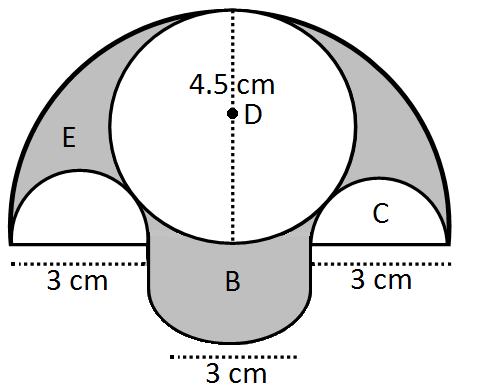
In the following figure, there are three semicircles, A, B and C having diameter 3cm each, and another semicircle E having a circle D with diameter 4.5cm are shown. Calculate:
The area of the shaded region.
The cost of painting the shaded region at the rate of 25 paise per $cm^2$​​​​​​​ , to the nearest rupee.
Find the zeros of the following quadratic polynomial and verify the relationship between the zeros and their coefficients:
$\text{f(x)}=\text{x}^2-\big(\sqrt{3}+1\big)\text{x}+\sqrt{3}$
In an A.P., if the $5^{\text {th }}$ and $12^{\text {th }}$ terms are 30 and 65 respectively, what is the sum of first 20 terms?
Short-Answer Question:
If $\alpha$ and $\beta$ are the zeroes of a polynomial $f(x) = 6x^2 + x - 2$, find the value of $\Big(\frac{\alpha}{\beta}+\frac{\beta}{\alpha}\Big).$
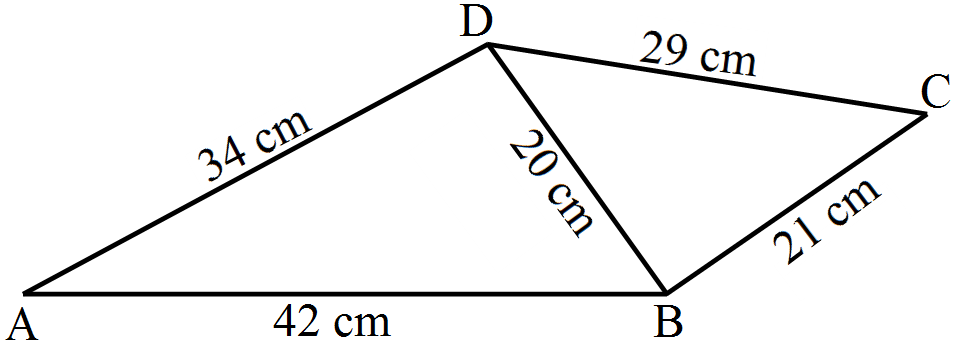
Find the area of the quadrilateral ABCD in which AB = 42cm, BC = 21cm, CD = 29cm, DA = 34cm and diagonal BD = 20cm.
Show that the following points are the vertices of a square:
A(6, 2), B(2, 1), C(1, 5) and D(5, 6)
Find the zeros of the following quadratic polynomial and verify the relationship between the zeros and their coefficients:
$\text{q(y)}=7\text{y}^2+\frac{11}{3}\text{y}-\frac{2}{3}$