Question
The difference between two numbers is $14$ and the difference between their squares is $448$. Find the numbers.

Answer

Let the numbers be $x$ and $y$ respectively.
According to the question:
$ x-y=14....(1) $
$ x^2-y^2=448....(2)$
From (1), we get:
$x=14+y....(3)$
Putting $x=14+y$ in $(2),$ we get
$ (14+y)^2-y^2=448 $
$ 196+y^2+28 y-y^2=448 $
$ 196+28 y=448 $
$ 28 y=448-196 $
$ y=\frac{252}{28} $
$ y=9$
Putting $y=9$ in $(1)$, we get
$ x-9=14 $
$ \Rightarrow x=14+9 $
$ \Rightarrow x=23$
Hence, the required numbers are $23$ and $9.$

Need a full question paper?

Generate a complete, print-ready paper with questions like this in minutes — across 16+ boards, with answer keys.
Start Generating Free

Similar questions

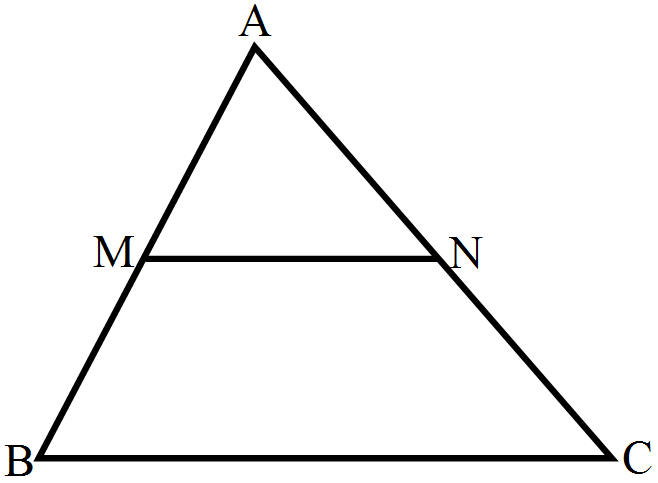
In the given figure, $MN || BC$ and $AM : MB = 1 : 2$
Find $\frac{\text{area}(\triangle\text{AMN})}{\text{area}(\triangle\text{ABC})}.$
Prove the following identities:
$\frac{\sin\theta}{(\sec\theta+\tan\theta)}+\frac{\cos\theta}{(\text{cosec }\theta+\cot\theta-1)}=1$
The points $(3, -4)$ and $(-6, 2)$ are the extremities of a diagonal of a parallelogram. If the third vertex is $(-1, -3).$ Find the coordinates of the fourth vertex.
The sum of the first $9$ terms of an $AP$ is $81$ and that of its first $20$ terms is $400$. Find the first and the common difference of the $AP.$
Solve each of the following given systems of equations graphically and find the vertices and area of the triangle formed by these lines and the x-axis:
$x - 2y + 2 = 0, 2x + y - 6 = 0$
Prove analytically that the line segment joining the middle points of two sides of a triangle is equal to half of the third side.
A bucket is in the form of a frustum of a cone. its depth is $15\ cm$ and the diameters of the top and the bottom are $56\ cm$ and $42\ cm$, respectively. Find how many litres of water can the bucket hold. $\Big[\text{Take}\ \pi=\frac{22}{7}.\Big]$
A ma saved $₹ 33000$ in $10$ month. In each month after the first, he saved ₹ $100$ more than he did in the preceding month. How much did he save in the first month?
The area of a triangle is $5$ sq.units. Two of its vertices are $(2,1)$ and $(3,-2)$. If the third vertex is $\left(\frac{7}{2}, y\right)$, find the value of $y$.
Prove that both the roots of the equation $(x - a)(x - b) + (x - b)(x - c) + (x - c)(x - a) = 0$ are real but they are equal only when $a = b = c.$