MCQ
The dimensional formula for $r.m.s.$ (root mean square) velocity is
  • ${M^0}L{T^{ - 1}}$
  • B
    ${M^0}{L^0}{T^{ - 2}}$
  • C
    ${M^0}{L^0}{T^{ - 1}}$
  • D
    $ML{T^{ - 3}}$

Answer

Correct option: A.
${M^0}L{T^{ - 1}}$
a
The dimensional formula for the $RMS$ velocity is same as the normal velocity.

So, dimension of $RMS$ velocity is $=\left[ M ^0 LT ^{-1}\right]$

Need a full question paper?

Generate a complete, print-ready paper with questions like this in minutes — across 16+ boards, with answer keys.

Start Generating Free

Similar questions

In a full wave rectifiers, input ac current has a frequency $‘v’$. The output frequency of current is
The radius of $R$ of a nucleus of mass number $A$ can be estimated by the formula $R =\left(1.3 \times 10^{-15}\right) A ^{1 / 3}\, m .$ It follows that the mass density of a nucleus is of the order of

$\left( M _{\text {prot. }} \cong M _{\text {neut. }}=1.67 \times 10^{-27} kg \right)$
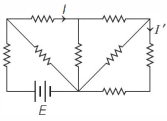
Consider the following circuit shown below. All the resistors are identical. The ratio of $I / I^{\prime}$ is
A particle travels $10\,m$ in first $5\, sec$ and $10\,m$ in next $3 \,sec$. Assuming constant acceleration what is the distance travelled in next $2 \,sec$..........$m$
A particle has simple harmonic motion. The equation of its motion is $x = 5\sin \left( {4t - \frac{\pi }{6}} \right)$, where $x$ is its displacement. If the displacement of the particle is $3$ units, then it velocity is
A drop of liquid of diameter $2.8\, mm$ breaks up into $125$ identical drops. The change in energy is nearly ......... $ergs$ (Surface tension $= 75\, dyne/cm$)
The specific heats at constant pressure is greater than that of the same gas at constant volume because
The two waves represented by  $ y_1 = a sin(\omega t) $ and ${y_2} = b\cos (\omega t)$ have a phase difference of
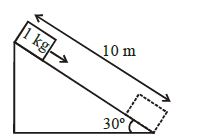
Find work done by friction if block reaches to the end with constant velocity
The ionization energy of the electron in the hydrogen atom in its ground state is $13.6\,\, eV.$ The atoms are excited to higher energy levels to emit radiations of $6$ wavelengths . Maximum wavelength of emitted radiation corresponds to the transition between