MCQ
The dimensions of $C{V^2}$ matches with the dimensions of
  • A
    ${L^2}I$
  • B
    ${L^2}{I^2}$
  • $L{I^2}$
  • D
    $\frac{1}{{LI}}$

Answer

Correct option: C.
$L{I^2}$
c
(c) Both are the formula of energy . $\left( {E = \frac{1}{2}C{V^2} = \frac{1}{2}L{I^2}} \right)$

Need a full question paper?

Generate a complete, print-ready paper with questions like this in minutes — across 16+ boards, with answer keys.
Start Generating Free

Similar questions

A closed organ pipe of length $l$ is sounded together with another closed organ pipe of length $l + x (x << l)$ both in fundamental mode. If $v$ = speed of sound, the beat frequency heard is
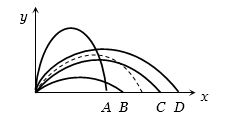
The path of a projectile in the absence of air drag is shown in the figure by dotted line. If the air resistance is not ignored then which one of the path shown in the figure is appropriate for the projectile
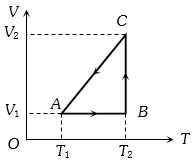
A cyclic process for $1\, mole$ of an ideal gas is shown in figure in the $V-T,$ diagram. The work done in $AB, BC$ and $CA$ respectively
One mole of an ideal gas requires $207\, J$ heat to raise the temperature by $10 \,K$ when heated at constant pressure. If the same gas is heated at constant volume to raise the temperature by the same $10\, K,$ the heat required is ...... $J$

(Given the gas constant $R = 8.3J/mol{\rm{ - }}K$)
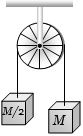
Two masses $M$ and $M/2$ are joint together by means of a light inextensible string passes over a frictionless pulley as shown in figure. When bigger mass is released the small one will ascend with an acceleration of
A particle moves in the X - Y plane according to the equation $\overrightarrow{\text{r}}=\Big(\overrightarrow{\text{i}}+2\overrightarrow{\text{j}}\Big)\text{A}\cos\omega\text{t}.$ The motion of the particle is:
  1. On a straight line.
  2. On an ellipse.
  3. Periodic.
  4. Simple harmonic.
The amount of heat energy required to raise the temperature of $1\, g$ of Helium at  $NTP,$ from $T_1 K$ to $T_2 K$ is 
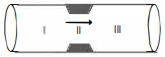
The platelets are drifting with the blood flowing in a streamline flow through a horizontal artery as shown below Artery is contracted in region $II$. Choose the correct statement.
Electromagnetic waves are produced by:
  1. A static charge.
  2. A moving charge.
  3. An accelerating charge.
  4. Chargeless particles.
The velocity $v$ of a particle as a function of its position $(x)$ is expressed as $v=\sqrt{c_1-c_2 x}$, where $c_1$ and $c_2$ are positive constants. The acceleration of the particle is