MCQ
The dimensions of inter atomic force constant are
  • $M T^{-2}$
  • B
    $M L T^{-1}$
  • C
    $M L T^{-2}$
  • D
    $M L^{-1} T^{-1}$

Answer

Correct option: A.
$M T^{-2}$
(a)
$K=Y \times r_0=\left[M L^{-1} T^{-2}\right] \times[L]=\left[M T^{-2}\right]$.
$Y=\text { Young's modulus and } r_0=\text { Interatomic distance }$

Need a full question paper?

Generate a complete, print-ready paper with questions like this in minutes — across 16+ boards, with answer keys.

Start Generating Free

Similar questions

If the energy of the photon is increased by a factor of $4$ , then its momentum
When the displacement is half the amplitude, the ratio of potential energy to the total energy is
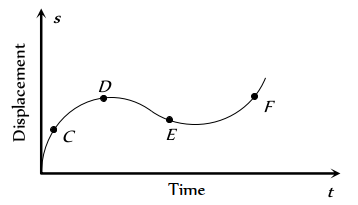
The displacement-time graph of moving particle is shown below The instantaneous velocity of the particle is negative at the pointImage
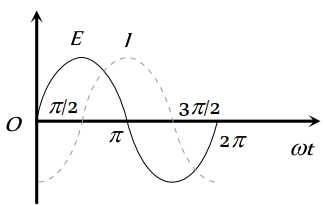
The variation of the instantaneous current $(I)$ and the instantaneous emf $(E)$ in a circuit is as shown in fig. Which of the following statements is correct
Image
The electric resistance of a certain wire of iron is $R$. If its length and radius are both doubled, then
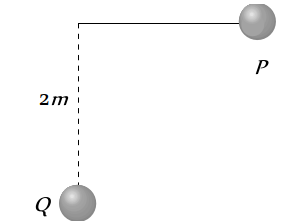
A pendulum of length $2 m$ lift at $P$. When it reaches $Q$, it losses $10 \%$ of its total energy due to air resistance. The velocity at $Q$ isImage
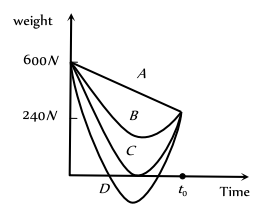
Suppose, the acceleration due to gravity at the earth's surface is 10 $\mathrm{m} / \mathrm{s}$ and at the surface of Mars it is $4.0 \mathrm{~m} / \mathrm{s}$. A $60 \mathrm{~kg}$ passenger goes from the earth to the Mars in a spaceship moving with a constant velocity. Neglect all other objects in the sky. Which part of figure best represents the weight (net gravitational force)of the passenger as a function of time.

Image

As the switch $S$ is closed in the circuit shown in figure, current passed through it isImage
A current carrying coil is placed with its axis perpendicular to $\mathrm{N}-\mathrm{S}$ direction. Let horizontal component of earth's magnetic field be $H$ and magnetic field inside the loop is $H$. If a magnet is suspended inside the loop, it makes angle $\theta$ with $H$. Then $\theta=$
A vessel contains $110 \mathrm{~g}$ of water. The heat capacity of the vessel is equal to $10 \mathrm{~g}$ of water. The initial temperature of water in vessel is $10^{\circ} \mathrm{C}$. If $220 \mathrm{~g}$ of hot water at $70^{\circ} \mathrm{C}$ is poured in the vessel, the final temperature neglecting radiation loss, will be