MCQ
The dimensions of Planck's constant and angular momentum are respectively
  • A
    $M{L^2}{T^{ - 1}}$ and $ML{T^{ - 1}}$
  • $M{L^2}{T^{ - 1}}$ and $M{L^2}{T^{ - 1}}$
  • C
    $ML{T^{ - 1}}$ and $M{L^2}{T^{ - 1}}$
  • D
    $ML{T^{ - 1}}$ and $M{L^2}{T^{ - 2}}$

Answer

Correct option: B.
$M{L^2}{T^{ - 1}}$ and $M{L^2}{T^{ - 1}}$
b
(b)

Need a full question paper?

Generate a complete, print-ready paper with questions like this in minutes — across 16+ boards, with answer keys.

Start Generating Free

Similar questions

The focal length of a normal eye-lens is about:
  1. 1mm.
  2. 2cm.
  3. 25cm.
  4. 1m.
According to the experiment of Ingen Hausz the relation between the thermal conductivity of a metal rod is $ K$ and the length of the rod whenever the wax melts is
From the top of a tower, two stones whose masses are in the ratio 1 : 2 are thrown, one straight up with an initial speed u and the second straight down with same speed u. neglecting air resistance,
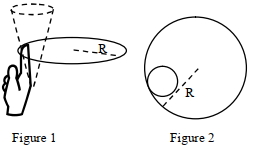
One twirls a circular ring (of mass $M$ and radius $R$ ) near the tip of one's finger as shown in Figure $1$ . In the process the finger never loses contact with the inner rim of the ring. The finger traces out the surface of a cone, shown by the dotted line. The radius of the path traced out by the point where the ring and the finger is in contact is $\mathrm{r}$. The finger rotates with an angular velocity $\omega_0$. The rotating ring rolls without slipping on the outside of a smaller circle described by the point where the ring and the finger is in contact (Figure $2$). The coefficient of friction between the ring and the finger is $\mu$ and the acceleration due to gravity is $g$.

(IMAGE)

($1$) The total kinetic energy of the ring is

$[A]$ $\mathrm{M} \omega_0^2 \mathrm{R}^2$   $[B]$ $\frac{1}{2} \mathrm{M} \omega_0^2(\mathrm{R}-\mathrm{r})^2$   $[C]$ $\mathrm{M \omega}_0^2(\mathrm{R}-\mathrm{r})^2$   $[D]$ $\frac{3}{2} \mathrm{M} \omega_0^2(\mathrm{R}-\mathrm{r})^2$

($2$) The minimum value of $\omega_0$ below which the ring will drop down is

$[A]$ $\sqrt{\frac{g}{\mu(R-r)}}$  $[B]$ $\sqrt{\frac{2 g}{\mu(R-r)}}$  $[C]$ $\sqrt{\frac{3 g}{2 \mu(R-r)}}$    $[D]$ $\sqrt{\frac{g}{2 \mu(R-r)}}$

Givin the answer quetion ($1$) and ($2$)
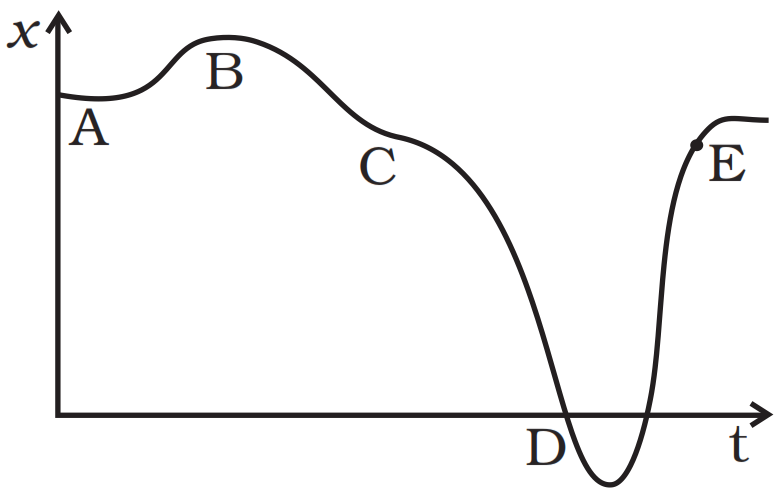
A graph of x versus t is shown in Fig. Choose correct alternatives from below:

Initial pressure and volume of a gas are $P$ and $V$ respectively. First it is expanded isothermally to volume $4V$ and then compressed adiabatically to volume $V$ . The final pressure of gas will be (given $\gamma = 3/2$ ) 
A body falling on the ground from $a$ height of $10\, m$, rebounds to a height $2.5\, m,$ then the ratio of the velocities of the body just before and after the collision will be
Two moles of an ideal monoatomic gas occupies a volume $V$ at $27^o C$. The gas expands adiabatically to a volume $2\ V$. Calculate $(a)$ the final temperature of the gas and $(b)$ change in its internal energy.
Which of the following have same dimensions?
The initial velocity of a projectile is $\vec u = (4\hat i + 3\hat j)\,m/s$ it is moving with uniform acceleration $\vec a = (0.4\hat i + 0.3\hat j)\, m/s^2$ The magnitude of its velocity after $10\,s$ is.........$m/s$