MCQ
The dimensions of pressure are
  • A
    $ML{T^{ - 2}}$
  • B
    $M{L^{ - 2}}{T^2}$
  • $M{L^{ - 1}}{T^{ - 2}}$
  • D
    $M^{-1}L^{-1}$

Answer

Correct option: C.
$M{L^{ - 1}}{T^{ - 2}}$
c
$ML ^{-1} T ^{-2}$

Pressure: $\frac{F \text { orce }}{\text { Area }}=\frac{\left[ MLT ^{-2}\right]}{\left[ L ^2\right]}=\left[ ML ^{-1} T ^{-2}\right]$

Need a full question paper?

Generate a complete, print-ready paper with questions like this in minutes — across 16+ boards, with answer keys.
Start Generating Free

Similar questions

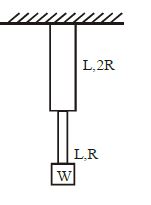
Two wires of the same material (Young's modulus  $Y$ ) and same length $L$  but radii  $R$  and  $2R$  respectively are joined end to end and a weight  $W$  is suspended from the combination as shown in the figure. The elastic potential energy in the system is
A body travels $102.5 \mathrm{~m}$ in $\mathrm{n}^{\text {th }}$ second and $115.0 \mathrm{~m}$ in $(n+2)^{\text {th }}$ second. The acceleration is :
The heat capacity of one mole an ideal is found to be $C_V=3 R(1+a R T) / 2$, where $a$ is a constant. The equation obeyed by this gas during a reversible adiabatic expansion is
A solid sphere and a hollow sphere of the same material and size are heated to the same temperature and allowed to cool in the same surroundings. If the temperature difference between each sphere and its surroundings is $T$, then
Consider a bowl filled with water on which some black pepper powder have been sprinkled uniformly. Now, a drop of liquid soap is added at the centre of the surface of water. The picture of the surface immediately after this will look like
A force of $50$ dynes is acted on a body of mass $5$ g which is at rest for an interval of $3$ seconds, then impulse is
Two vessels $A$ and $B$ are of the same size and are at same temperature. A contains $1 \mathrm{~g}$ of hydrogen and $B$ contains $1 \mathrm{~g}$ of oxygen. $\mathrm{P}_{\mathrm{A}}$ and $\mathrm{P}_{\mathrm{B}}$ are the pressures of the gases in $A$ and $\mathrm{B}$ respectively, then $\frac{\mathrm{P}_{\mathrm{A}}}{\mathrm{P}_{\mathrm{B}}}$ is:
One mole of an ideal gas $(\gamma  = 1.4)$ is adiabatically compressed so that its temperature rises from $27\,^oC$ to $35\,^oC$. The change in the internal energy of the gas is  .... $J$ (given $R = 8.3 \,J/mole/K$)
Consider two cylindrical rods of identical dimensions, one of rubber and the other of steel. Both the rods are fixed rigidly at one end to the roof. A mass M is attached to each of the free ends at the centre of the rods.
The molecules of a given mass of a gas have $r.m.s.$ velocity of $200 \,m s^{-1}$ at $27^o C$ and $1.0 \times 10^5 \,Nm^{-2}$ pressure. When the temperature and pressure of the gas are respectively, $127^o C$ and $0.05 \times 10^5 \,Nm^{-2},$ the $r.m.s.$ velocity of its molecules in $m s^{-1}$ is