MCQ
The dimensions of universal gravitational constant is
  • A
    $\left[ M ^{-2} L^2 T^{-1}\right]$
  • $\left[ M ^{-1} L^3 T^{-2}\right]$
  • C
    $\left[ M ^{-2} L^3 T^{-2}\right]$
  • D
    $\left[ ML ^2 T^{-1}\right]$

Answer

Correct option: B.
$\left[ M ^{-1} L^3 T^{-2}\right]$
(B) $\left[ M ^{-1} L^3 T^{-2}\right]$

Need a full question paper?

Generate a complete, print-ready paper with questions like this in minutes — across 16+ boards, with answer keys.

Start Generating Free

Similar questions

A car is negotiating a curved road of radius $R$. The road is banked at an angle $\theta .$ The coefficient of friction between the tyres of the car and the road is $\mu _s.$ The maximum safe velocity on this road is
A rifle man, who together with his rifle has a mass of $100\,kg$, stands on a smooth surface and fires $10$ shots horizontally. Each bullet has a mass $10\,g$ and a muzzle velocity of $800\,ms ^{-1}$. The velocity which the rifle man attains after firing $10$ shots is $..........\,ms^{-1}$
There is a hole in the bottom of tank having water. If total pressure at bottom is $ 3 atm$  ($1 atm = 10^5N/m^2$) then the velocity of water flowing from hole is
$A$ block of mass $m$ is kept in an elevation which starts moving downward with an acceleration $a$ as shown in figure. The block is observed by two observers $A$ and $B$ for $a$ time interval $t_0$. According to the observer $A$
Two trains each of length $100 \,m$ moving parallel towards each other at speed $72 \,km / h$ and $36 \,km / h$ respectively. In how much time will they cross each other is ..........
In Bohr's model of hydrogen-like species, which of the following is true?
An electron of mass $m$ when accelerated through a potential difference $V$ has de-Broglie wavelength $\lambda $. The de-Broglie wavelength associated with a proton of mass $M$ accelerated through the same potential difference will be
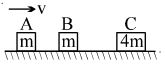
Three blocks are initially placed as shown in the figure. Block $A$ has mass $m$ and initial velocity $v$ to the right. Block $B$ with mass $m$ and block $C$ with mass $4m$ are both initially at rest. Neglect friction. All collisions are elastic. The final velocity of block $A$ is
In a sonometer wire, the tension is maintained by suspending a $50.7 kg$ mass from the free end of the wire. The suspended mass has a volume of $ 0.0075 \, m^3$. The fundamental frequency of the wire is $260 Hz$. If the suspended mass is completely submerged in water, the fundamental frequency will become .... $Hz$ (take $g = 10 ms^{-2}$)
A particle of mass $m$ travelling along $x-$ axis with speed $v_0$ shoots out $1/3^{rd}$ of its mass with a speed $2v_0$ along $y-$ axis. The velocity of remaining piece is