MCQ
The dimesisation of $NO_2$ is accompanied with
  • A
    An increase in paramagnetism
  • a decreases in paramegnetism
  • C
    No change in paramagnetism
  • D
    A darkening in colour

Answer

Correct option: B.
a decreases in paramegnetism
b

Need a full question paper?

Generate a complete, print-ready paper with questions like this in minutes — across 16+ boards, with answer keys.

Start Generating Free

Similar questions

Consider the following reaction

(image) $\xrightarrow[{Pd - BaS{O_4}}]{{{H_2}}}\,A$

The product $A$ is
Given below are two statements: One is labelled as Assertion (A) and the other is labelled as Reason (R)
Assertion (A): Enthalpy of neutralisation of strong monobasic acid with strong monoacidic base is always $-57 kJ mol ^{-1}$ 
Reason (R): Enthalpy of neutralisation is the $H ^{+}$ amount of heat liberated when one mole of H ions furnished by acid combine with one mole of ${ }^{-} OH$ ions furnished by base to form one mole of water. In the light of the above statements, choose the correct answer from the options given below.
Chloroform, on warming with  $ Ag$  powder, gives
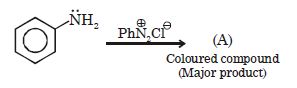
The coloured major product formed in above reaction is 
Which of the following is not correct about transition metals
Determine enthalpy of formation for $H_2O_2(l)$, using listed enthalpies of reaction

${N_2}{H_4}\left( l \right) + 2{H_2}{O_2}\left( l \right) \to \mathop {{N_2}\left( g \right) + 4{H_2}O\left( l \right);}\limits_{{\Delta_r} H_1^o =  - 818\,kJ/mol} $

${N_2}{H_4}\left( l \right) + {O_2}\left( g \right) \to \mathop {{N_2}\left( g \right) + 2{H_2}O\left( l \right);}\limits_{{\Delta _r}H_2^o =  - 622\,kJ/mol} $

${H_2}\left( g \right) + \frac{1}{2}{O_2}\left( g \right) \to \mathop {{H_2}O\left( l \right);}\limits_{{\Delta _r}H_3^o =  - 285\,kJ/mol} $

.......$kJ/mol$
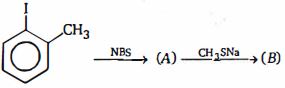
Product $(B)$ is
Which is incorrect numbering in the following compounds as per $IUPAC$ rules ?
Resistance of a conductivity cell (cell constant $129 \;m ^{-1}$ ) filled with $74.5\; ppm$ solution of $KCl$ is $100\; \Omega$ (labelled as solution 1). When the same cell is filled with $KCl$ solution of $149 \;ppm$, the resistance is $50\; \Omega$ (labelled as solution 2). The ratio of molar conductivity of solution $1$ and solution $2$ is i.e. $\frac{\wedge_{1}}{\wedge_{2}}=x \times 10^{-3}$. The value of $x$ is

(Nearest integer)

Given, molar mass of $KCl$ is $74.5 g mol ^{-1}$

The number of monochloroproduct formed from $n-$ butane are