MCQ
The diode shown in the circuit is a silicon diode. The potential difference between the points A and B will be
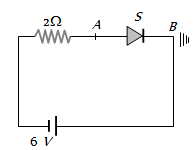
  • 6 V
  • B
    0.6 V
  • C
    0.7 V
  • D
    0 V

Answer

Correct option: A.
6 V
6 V

Need a full question paper?

Generate a complete, print-ready paper with questions like this in minutes — across 16+ boards, with answer keys.

Start Generating Free

Similar questions

Three observers $A, B$ and $C$ measure the speed of light coming from a source to be $vA, 0B$ and $vc.$ The observer $A$ moves towards the source and $C$ moves away from the source at the same speed. The observer $B$ stays stationary. The surrounding space is vacuum everywhere.
A dimensionless quantity:
Mosley measured the frequency $(f)$ of the characteristic $X-$ rays from many metals of different atomic number $(Z)$ and represented his results by a relation known as Mosley's law. This law is ($a, b$ are constants)
$X -$ rays and $\gamma - $rays of the same energies may be distinguished by
A proton and an alpha particle both enter a region of uniform magnetic field $B,$ moving at right angles to field $B$. If the radius of circular orbits for both the particles is equal and the kinetic energy acquired by proton is $1 \ MeV$ the energy acquired by the alpha particle will be:
A charge of $5\,C$ experiences a force of $5000\,N$ when it is kept in a uniform electric field. .........$V$ is the potential difference between two points separated by a distance of $1\,cm$
A straight copper wire is moved in a uniform magnetic field such that it cuts the magnetic lines of force. Then
A lamp consumes only $50\%$ of peak power in an $a.c.$ circuit. What is the phase difference between the applied voltage and the circuit current
Barrier potential of a P-N junction diode does not depend on
The half life period of a radioactive element $X$ is same as the mean life time of another radioactive element $Y$. Initially both of them have the same number of atoms. Then