MCQ
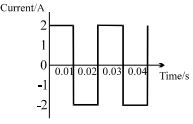
The direct current which would give the same heating effect in an equal constant resistance as the current shown in figure, i.e. the $r.m.s.$ current, is.....$A$
  • A
    $0$
  • B
    $\sqrt 2$
  • $2$
  • D
    $2 \sqrt 2 $

Answer

Correct option: C.
$2$
c

Need a full question paper?

Generate a complete, print-ready paper with questions like this in minutes — across 16+ boards, with answer keys.
Start Generating Free

Similar questions

You are holding a shallow circular container of radius $R$, filled with water to a height $h ( h < < R )$. When yon walk with speed $v$, it is seen that water starts spilling over. This happens due to the resonance of the periodic impulse given to the container (due to walking) with the oscillation of the water in the container. If the time period of water oscillating in the container is inversely proportional to $\sqrt{ h }$, then $v$ is proportional to
In the figure shown consider the first reflection at the plane mirror and second at the convex mirror. $AB$ is object.
The lead wires should have
Which of the following rays has the maximum frequency
A cell $E _{1}$ of $emf 6 V$ and internal resistance $2 \Omega$ is connected with another cell $E _{2}$ of $emf 4 V$ and internal resistance $8 \Omega$ (as shown in the figure). The potential difference across points $X$ and $Y$ is............ $V$
$A$ uniform chain of length $2L$ is hanging in equilibrium position, if end $B$ is given a slightly downward displacement the imbalance causes an acceleration. Here pulley is small and smooth & string is inextensible The velocity $v$ of the string when it slips out of the pulley (height of pulley from floor $> 2L$)
Two wires of same length and radius are joined end to end and loaded. The Young's modulii of the materials of the two wires are $Y_{1}$ and $Y_{2}$. The combination behaves as a single wire then its Young's modulus is:
A geostationary satellite orbits around the earth in a circular orbit of radius $36000\, km$. Then, the time period of a satellite orbiting a few hundred kilometres above the earth’s surface $({R_{{\rm{Earth}}}} = 6400\,km)$ will approximately be ....... $hours$
Starting with a sample of pure ${}^{66}Cu,\frac{7}{8}$ of it decays into $Zn$ in $15\, minutes$. The corresponding half life is..........$minutes$
$Assertion :$ Resonance is a special case of forced vibration in which the natural frequency of vibration of the body is the same as the impressed frequency of external periodic force and the amplitude of forced vibration is maximum.
$Reason :$ The amplitude of forced vibrations of a body increases with an increase in the frequency of the externally impressed periodic force.