MCQ
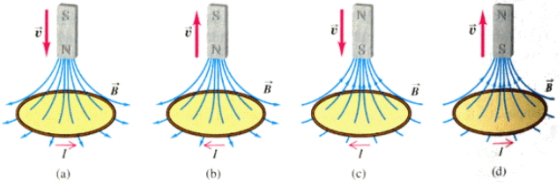
The direction of induced e.m.f. during electromagnetic induction is given by
  • A
    Faraday's law
  • Lenz's law
  • C
    Maxwell's law
  • D
    Ampere's law

Answer

Correct option: B.
Lenz's law
b
(b) The rule is called Lenz's Law. You already appear to know how to determine the direction of the magnetic field due to a current in a loop, which is part of the answer. What Lenz's Law tells us is that the direction of the induced current in the loop is such that it "opposes the change in the flux".

Need a full question paper?

Generate a complete, print-ready paper with questions like this in minutes — across 16+ boards, with answer keys.

Start Generating Free

Similar questions

A current of $2\, A$ passing through conductor produces $80\, J$ of heat in $10$ seconds. The resistance of the conductor is ............ $\Omega$
An object is gradually moving away from the focal point of a concave mirror along the axis of the mirror. The graphical representation of the magnitude of linear magnification $(m)$ versus distance of the object from the mirror $(x)$ is correctly given by

(Graphs are drawn schematically and are not to scale)
Minimum number of capacitors of $2\,\mu F$ capacitance each required to obtain a capacitor of $5\,\mu F$ will be
A double convex lens of glass of m = 1.5 has radius of curvature of each of its surface is 0.2 m. The power of the lens is
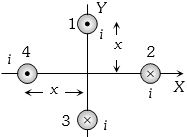
What will be the resultant magnetic field at origin due to four infinite length wires. If each wire produces magnetic field '$B$' at origin
A charged particle moves along circular path in a uniform magnetic field in a cyclotron. The kinetic energy of the charged particle increases to $4$ times its initial value. What will be the ratio of new radius to the original radius of circular path of the charged particle
A ray of light transmits from glass (refractive index $=$ $3 / 2$ ) to water (refractive index $=4 / 3$ ). The value of critical angle will be :
An $LC$ circuit consists of a capacitor and a coil with a large number of turns. Suppose all the linear dimensions of all elements of the circuit are increased by a factor of $2$ while keeping the number of turns on the coil constant. How much does the resonant frequency of the circuit change?
A current of $2\,A$ flows through a wire of crosssectional area $25.0\,mm ^2$. The number of free electrons in a cubic meter are $2.0 \times 10^{28}$. The drift velocity of the electrons is $...............\times 10^{-6}\,ms ^{-1}$ (given, charge on electron $=1.6 \times 10^{-19}\,C$ )
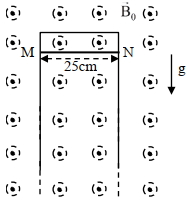
A thin conducting rod $\mathrm{MN}$ of mass $20 \mathrm{gm}$, length $25 \mathrm{~cm}$ and resistance $10 \Omega$ is held on frictionless, long, perfectly conducting vertical rails as shown in the figure. There is a uniform magnetic field $\mathrm{B}_0=4 \mathrm{~T}$ directed perpendicular to the plane of the rod-rail arrangement. The rod is released from rest at time $t=0$ and it moves down along the rails. Assume air drag is negligible. Match each quantity in List-$I$ with an appropriate value from List-$II$, and choose the correct option. [Given: The acceleration due to gravity $g=10 \mathrm{~ms}^{-2}$ and $e^{-1}=0.4$ ]
List-$I$ List-$II$
($P$) At $t=0.2 \mathrm{~s}$, the magnitude of the induced emf in Volt ($1$) $\quad 0.07$
($Q$) At $t=0.2 \mathrm{~s}$, the magnitude of the magnetic force in Newton $(2) 0.14$
($R$) At $t=0.2 \mathrm{~s}$, the power dissipated as heat in Watt $(3) 1.20$
($S$) The magnitude of terminal velocity of the rod in $\mathrm{m} \mathrm{s}^{-1}$ $(4) 0.12$
  $(5) 2.00$