MCQ
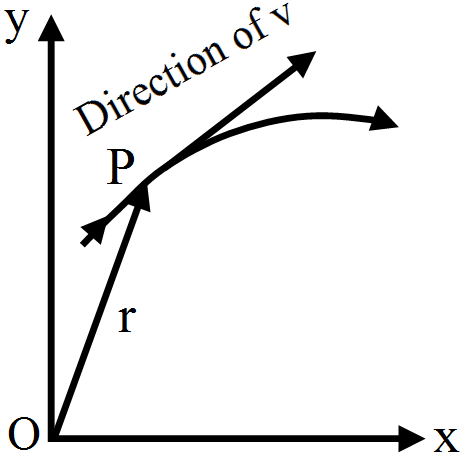
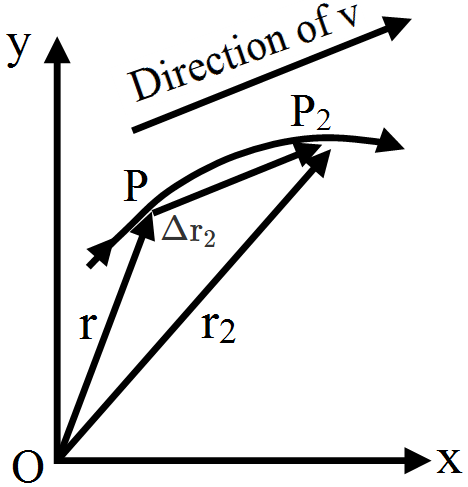
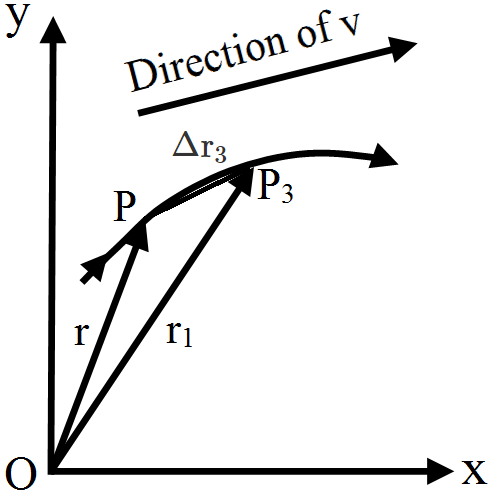
The direction of instantaneous velocity is show by:
  • A
  • B
  • D
    None of these.

Answer

Correct option: C.

Need a full question paper?

Generate a complete, print-ready paper with questions like this in minutes — across 16+ boards, with answer keys.
Start Generating Free

Similar questions

A pipe $30 cm$ long is open at both ends. Which harmonic mode of the pipe is resonantly excited by a $1.1 kHz$ source ? (Take speed of sound in air =$ 330 ms^{-1}$)
A Carnot's engine used first an ideal monoatomic gas then an ideal diatomic gas. If the source and sink temperature are ${411^o}C$ and ${69^o}C$ respectively and the engine extracts $1000\, J $ of heat in each cycle, then area enclosed by the $PV$ diagram is ........ $J$
Two particles $X$ and $Y$ having equal charge, after being accelerated through the same potential difference enter a region of uniform magnetic field and describe circular paths of radii $R_1$ and $R_2$ respectively. The ratio of the mass of $X$ to that of $Y$ is:
A particle moving in a circle of radius $R$ with a uniform speed takes a time $T$ to complete one revolution. If this particle were projected with the same speed at an angle ' $\theta$ ' to the horizontal, the maximum height attained by it equals $4 \mathrm{R}$. The angle of projection, $\theta$, is then given by
For a projectile the ratio of maximum height reached to the square of flight time is
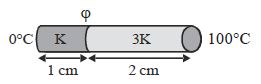
Two bars of thermal conductivities $K$ and $3K$ and lengths $1\,\, cm$ and $2\,\, cm$ respectively have equal cross-sectional area, they are joined lengths wise as shown in the figure. If the temperature at the ends of this composite bar is $0\,^oC$ and $100\,^oC$ respectively (see figure), then the temperature $\varphi $ of the interface is......... $^oC$
A particle of mass $m$ describes a circle of radius $r$. The centripetal acceleration of the particle is $4/r^2$. What will be the momentum of the particle?
A given system undergoes a change in which work done by the system equals the decrease in its internal energy. The system must have undergone:
The surface tension of soap solution is $25 \times {10^{ - 3}}\,N{m^{ - 1}}$. The excess pressure inside a soap bubble of diameter $1 \,cm$ is ....... $Pa$
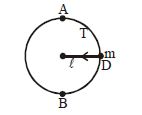
A particle of mass $m$ , attached with a string of length $l$ is moving in a vertical circle. If the particle is just looping the loop without slackening of the string and $v_A, v_B, v_D$ are speeds at positions $A, B, D$ shown in figure, then