Question
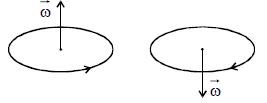
The direction of the angular velocity vector along
Answer

Angular velocity is a vector whose direction is perpendicular to the plane of circular path or axis of rotation. Its direction has been shown in the figure

Need a full question paper?

Generate a complete, print-ready paper with questions like this in minutes — across 16+ boards, with answer keys.
Start Generating Free

Similar questions

We have half a bucket $(6l)$ of water at $20\,^oC$  . If we want water at $40\,^oC$, how much steam at $100\,^oC$ should be added to it ?
A wire fixed at the upper end stretches by length $l$ by applying a force $F$. The work done in stretching is
A $6\,\,V$ battery is connected to the terminals of a $3\, m$ long uniform wire having resistance $100\,\Omega $. The difference in potential between two points on the wire separated by a distance of $50\,  cm$ will be ............. $V$
A particle of mass $m$ moving with velocity $v$ collides with a stationary particle of mass $2m$. After collision, they stick together and continue to move together with velocity ........
A circular plate of uniform thickness of diameter $56\, cm$, whose center is at origin. A circular part of diameter $42\, cm$ is removed from one edge. What is the distance of the centre of mass of the remaining part ........ $cm.$
If the wavelength of light in vacuum be $\lambda$, the wavelength in a medium of refractive index $n$ will be
A force $F$ acts between sodium and chlorine ions of salt (sodium chloride) when put $1\,cm$ apart in air. The permittivity of air and dielectric constant of water are ${\varepsilon _0}$ and $K$ respectively. When a piece of salt is put in water electrical force acting between sodium and chlorine ions $1\,cm$ apart is
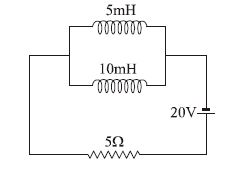
In the given circuit, the current through $5mH$ indicator in steady state is
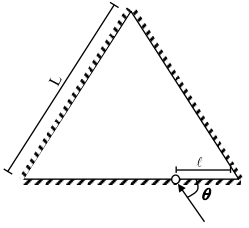
Three plane mirrors form an equilateral triangle with each side of length $L$. There is a small hole at a distance $l > 0$ from one of the comers as shown in the figure. A ray of light is passed through the hole at an angle $\theta$ and can only come out through the same hole. The cross section of the mirror configuration and the ray of light lie on the same plane.

Which of the following statement($s$) is(are) correct?

$(A)$ The ray of light will come out for $\theta=30^{\circ}$, for $0 < l < L$.

$(B)$ There is an angle for $l=\frac{L}{2}$ at which the ray of light will come out after two reflections.

$(C)$ The ray of light will $NEVER$ come out for $\theta=60^{\circ}$, and $l=\frac{L}{3}$.

$(D)$ The ray of light will come out for $\theta=60^{\circ}$, and $0 < l < \frac{L}{2}$ after six reflections.
Consider all possible isomeric ketones, including stereoisomers of $MW$ $=100$. All these isomers are idependently reacted with $NaBH _4$ ($NOTE$ : stereoisomers are also reacted separately). The total number of ketones that give a racemic product$(s)$ is/are