MCQ
The dispersive power is maximum for the material
  • Flint glass
  • B
    Crown glass
  • C
    Mixture of both
  • D
    None of the above

Answer

Correct option: A.
Flint glass
a
Refractive Index of Flint Glass $(\mu=1.65)$ is relatively higher than Refractive Index of Crown Glass $(\mu=1.51)$. Since dispersive power is dependent on the Refractive Index so for Flint glass dispersive power is maximum.

Need a full question paper?

Generate a complete, print-ready paper with questions like this in minutes — across 16+ boards, with answer keys.

Start Generating Free

Similar questions

Assuming the sun to have a spherical outer surface of radius $r$, radiating like a black body at temperature $t^o C$, the power received by a unit surface, (normal to the incident rays) at a distance $R$ from the centre of the sun is

where $\sigma$ is the Stefan's constant.
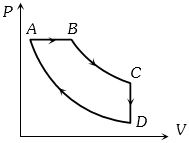
A cyclic process $ABCD$ is shown in the figure $P-V$ diagram. Which of the following curves represent the same process
A vessel of depth $2d\, cm$ is half filled with a liquid of refractive index ${\mu _1}$ and the upper half with a liquid of refractive index ${\mu _2}$. The apparent depth of the vessel seen perpendicularly is
Assertion : In the absence of an external electric field, the dipole moment per unit volume of a polar dielectric is zero.

Reason : The dipoles of a polar dielectric are randomly oriented.
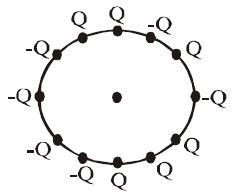
Point charges are fixed at the hour marks of a wall clock as shown. If net dipole moment of the system is along the direction of hour hand then time shown by clock is 
A horizontal platform with an object placed on it is executing $S.H.M$. in the vertical direction. The amplitude of oscillation is $3.92 \times {10^{ - 3}}m$. What must be the least period of these oscillations, so that the object is not detached from the platform
A milli voltmeter of $25$ $milli$ $volt$ range is to be converted into an ammeter of $25$ $ampere$ range. The value (in $ohm$) of necessary shunt will be
A point charge of $2.0\; \mu \,C$ is at the centre of a cubic Gaussian surface $9.0\; cm$ on edge. What is the net electric flux through the surface?
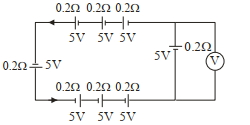
The reading in the ideal voltmeter $(V)$ shown in the given circuit diagram is :
A body initially at rest, breaks up into two pieces of masses $2 M$ and $3 M$ respectively, together having a total kinetic energy $E$. The piece of mass $2 M$, after breaking up, has a kinetic energy