The displacement of a particle along the $x-$ axis is given by $x=asin^2$$\omega t$ . The motion of the particle corresponds to
AIPMT 2010, Medium
Download our app for free and get started
$x=a \sin ^{2} \omega t=a\left(\frac{1-\cos 2 \omega t}{2}\right)$
$\left(\because \cos 2 \theta=1-2 \sin ^{2} \theta\right) $
$= \frac{a}{2}-\frac{a \cos 2 \omega t}{2}$
$\therefore \quad$ Velocity, $v=\frac{d x}{d t}=\frac{2 \omega a \sin 2 \omega t}{2}=\omega a \sin 2 \omega t$
Acceleration, $a=\frac{d v}{d t}=2 \omega^{2} a \cos 2 \omega t$
For the given displacement $x=a \sin ^{2} \omega t,$
$a \propto-x$ is not satisfied.
Hence, the motion of the particle is non simple harmonic motion.

Download our appand get started for free
Experience the future of education. Simply download our apps or reach out to us for more information. Let's shape the future of learning together!No signup needed.*
Similar Questions
- 1A particle of mass $m$ is performing linear simple harmonic motion. Its equilibrium is at $x = 0,$ force constant is $K$ and amplitude of $SHM$ is $A$. The maximum power supplied by the restoring force to the particle during $SHM$ will beView Solution
- 2Column $I$ gives a list of possible set of parameters measured in some experiments. The variations of the parameters in the form of graphs are shown in Column $II$. Match the set of parameters given in Column $I$ with the graph given in Column $II$. Indicate your answer by darkening the appropriate bubbles of the $4 \times 4$ matrix given in the $ORS$.View Solution
Column $I$ Column $II$ $(A)$ Potential energy of a simple pendulum (y axis) as a function of displacement ( $\mathrm{x}$ axis) $Image$ $(B)$ Displacement (y axis) as a function of time (x axis) for a one dimensional motion at zero or constant acceleration when the body is moving along the positive $\mathrm{x}$-direction $Image$ $(C)$ Range of a projectile (y axis) as a function of its velocity ( $\mathrm{x}$ axis) when projected at a fixed angle $Image$ $(D)$ The square of the time period (y axis) of a simple pendulum as a function of its length ( $\mathrm{x}$ axis) $Image$ 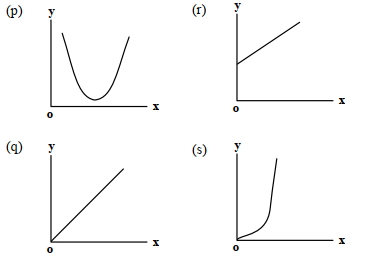
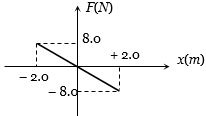
- 3A body of mass $0.01 kg$ executes simple harmonic motion $(S.H.M.)$ about $x = 0$ under the influence of a force shown below : The period of the $S.H.M.$ is .... $s$View Solution
- 4The $K.E.$ and $P.E.$ of a particle executing $SHM$ with amplitude $A$ will be equal when its displacement is-View Solution
- 5Two particles executing $S.H.M.$ of same frequency, meet at $x=+A / 2$, while moving in opposite directions. Phase difference between the particles is .........View Solution
- 6A particle moves along a circle with a constant angular speed $\omega$ Its displacement,with respect to this position of the particle at time $t = 0$ is plotted against time. The graph would look likeView Solution
- 7Acceleration of a particle, executing $SHM$, at it’s mean position isView Solution
- 8Equations $y = 2A \cos ^2 \omega \,t$ and $y = A (\sin \omega t + \cos \omega t )$ represent the motion of two particles.View Solution
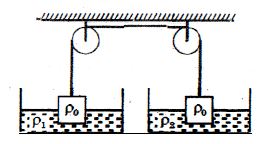
- 9Consider two identical cylinders [each of mass $m$ density $\rho _0$ horizontal cross-section area $s$] in equilibrium, partially submerged in two containers filled with liquids of densities $\rho_1$ and $\rho_2$ as shown in figure. Find the period of small oscillations of this system about its equilibrium. Neglect the changes in the level of liquids in the containers. Neglect mass of the strings. acceleration due to gravity is $g$ . ($v$ is volume of each block)View Solution
- 10If a particle under S.H.M. has time period 0.1 sec and amplitude $2 \times 10^{-3}$. It has maximum velocityView Solution