The displacement of an oscillator is given by $x = a\, \sin \, \omega t + b\, \cos \, \omega t$. where $a, b$ and $\omega$ are constant. Then :-
Medium
Download our app for free and get started
$x=\sin \omega t+b \cos \omega t$
$\mathrm{x}=\sqrt{\mathrm{a}^{2}+\mathrm{b}^{2}}\left[\frac{\mathrm{a}}{\mathrm{a}^{2}+\mathrm{b}^{2}} \sin \omega \mathrm{t}+\frac{1}{\sqrt{\mathrm{a}^{2}+\mathrm{b}^{2}}} \cos \omega \mathrm{t}\right]$
$\mathrm{x}=\sqrt{\mathrm{a}^{2}+\mathrm{b}^{2}}[\cos \phi \sin \omega \mathrm{t}+\sin \phi \cos \omega \mathrm{t}]$
Let $\cos \phi=\frac{a}{\sqrt{a^{2}+b^{2}}}$
$\therefore \mathrm{x}_{2} \sqrt{\mathrm{a}^{2}+\mathrm{b}^{2}} \sin (\omega \mathrm{t}+\phi)$ this is condition of $SHM$

Download our appand get started for free
Experience the future of education. Simply download our apps or reach out to us for more information. Let's shape the future of learning together!No signup needed.*
Similar Questions
- 1A block of mass $m$ attached to massless spring is performing oscillatory motion of amplitude $'A'$ on a frictionless horizontal plane. If half of the mass of the block breaks off when it is passing through its equilibrium point, the amplitude of oscillation for the remaining system become $fA.$ The value of $f$ isView Solution
- 2silver atom in a solid oscillates in simple harmonic motion in some direction with a frequency of $10^{12} /sec$. What is the force constant of the bonds connecting one atom with the other? ................ $\mathrm{N/m}$ (Mole wt. of silver $= 108 $ andAvagadro number $= 6.02 \times 10^{23}$ $gm \ mole^{ -1}$ )View Solution
- 3View SolutionFor a particle executing simple harmonic motion, which of the following statements is not correct
- 4A particle is executing simple harmonic motion with a time period $T.$ At time $t = 0$, it is at its position of equilibrium. The kinetic energy-time graph of the particle will look likeView Solution
- 5Column $I$ gives a list of possible set of parameters measured in some experiments. The variations of the parameters in the form of graphs are shown in Column $II$. Match the set of parameters given in Column $I$ with the graph given in Column $II$. Indicate your answer by darkening the appropriate bubbles of the $4 \times 4$ matrix given in the $ORS$.View Solution
Column $I$ Column $II$ $(A)$ Potential energy of a simple pendulum (y axis) as a function of displacement ( $\mathrm{x}$ axis) $Image$ $(B)$ Displacement (y axis) as a function of time (x axis) for a one dimensional motion at zero or constant acceleration when the body is moving along the positive $\mathrm{x}$-direction $Image$ $(C)$ Range of a projectile (y axis) as a function of its velocity ( $\mathrm{x}$ axis) when projected at a fixed angle $Image$ $(D)$ The square of the time period (y axis) of a simple pendulum as a function of its length ( $\mathrm{x}$ axis) $Image$ 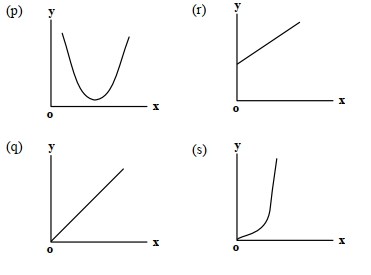
- 6The displacement of a body executing $SHM$ is given by $x = A \sin (2\pi t + \pi /3).$ The first time from $t = 0$ when the velocity is maximum is .... $\sec$View Solution
- 7A linear harmonic oscillator of force constant $2 \times 10^6\,Nm^{-1}$ and amplitude $0.01\, m$ has a total mechanical energy of $160\, J.$ ItsView Solution
- 8The period of oscillation of a simple pendulum of length $L$ suspended from the roof of a vehicle which moves without friction down an inclined plane of inclination $\alpha$, is given byView Solution
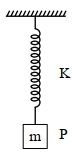
- 9In simple harmonic motion, the total mechanical energy of given system is E. If mass of oscillating particle $P$ is doubled then the new energy of the system for same amplitude is:View Solution
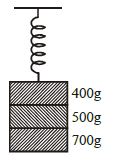
- 10Three mass and string system is in equilibrium. When $700\,gm$ mass is removed, then the system oscillates with a period of $3\,seconds$ . When the $500\,gm$ mass is also removed, then what will be new time period for system ..... $\sec$View Solution