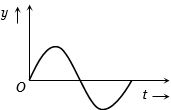
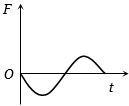
The displacement time graph of a particle executing $S.H.M.$ is as shown in the figureThe corresponding force-time graph of the particle is
- A
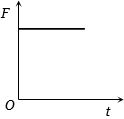
- B
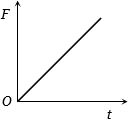
- C
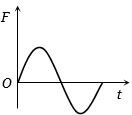
- D
Easy


Download our appand get started for free
Experience the future of education. Simply download our apps or reach out to us for more information. Let's shape the future of learning together!No signup needed.*
Similar Questions
- 1The displacement of an oscillating particle varies with time (in seconds) according to the equation $y (cm) = sin \frac{\pi }{2}\left( {\frac{t}{2} + \frac{1}{3}} \right)$. The maximum acceleration of the particle is approximately ..... $cm/s^2$View Solution
- 2The motion of a particle represented by $y\ =$ $\sin \omega t - \cos \omega t$ isView Solution
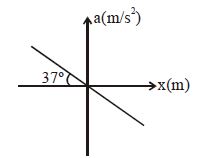
- 3The acceleration displacement graph of a particle executing $SHM$ is shown in figure. The time period of simple harmonic motion isView Solution
- 4The displacement of a particle executing SHM is given by $x=10 \sin \left(\omega t+\frac{\pi}{3}\right) \mathrm{m}$. The time period of motion is $3.14 \mathrm{~s}$. The velocity of the particle at $\mathrm{t}=0$is_________. $\mathrm{m} / \mathrm{s}$.View Solution
- 5Four harmonic waves of equal frequencies and equal intensities $I_0$ have phase angles $0, \pi / 3,2 \pi / 3$ and $\pi$. When they are superposed, the intensity of the resulting wave is $nI _0$. The value of $n$ isView Solution
- 6A particle is placed at the lowest point of a smooth wire frame in the shape of a parabola, lying in the vertical $xy-$ plane having equation $x^2 = 5y$ $(x, y$ are in meter). After slight displacement, the particle is set free. Find angular frequency of oscillation.....$rad/s$ (in $rad/sec$ ) (take $g = 10\ m/s^2$ )View Solution
- 7View SolutionIn S.H.M. maximum acceleration is at
- 8Amplitude of a mass-spring system, which is executing simple harmonic motion decreases with time. If mass $=500\, g$, Decay constant $=20 \,g / s$ then ...... $s$ time is required for the amplitude of the system to drop to half of its initial value ? $(\ln 2=0.693)$View Solution
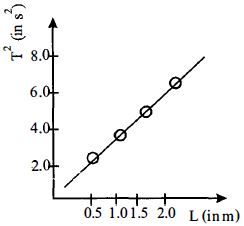
- 9In an experiment for determining the gravitational acceleration $g$ of a place with the help of a simple pendulum, the measured time period square is plotted against the string length of the pendulum in the figure. What is the value of $g$ at the place? ...... $m/s^2$View Solution
- 10The function $sin^2\,(\omega t)$ representsView Solution