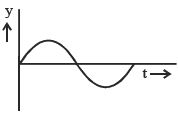
The displacement versus time graph of $SHM$ is Which of the following is its acceleration versus time graph ?
Easy
Download our app for free and get started

Download our appand get started for free
Experience the future of education. Simply download our apps or reach out to us for more information. Let's shape the future of learning together!No signup needed.*
Similar Questions
- 1A particle of mass $10 \,g$ is undergoing $S.H.M.$ of amplitude $10 \,cm$ and period $0.1 \,s$. The maximum value of force on particle is about ............ $N$View Solution
- 2A pendulum is formed by pivoting a disc. What distance from center of mass, it should be pivoted for minimum time period while performing $SHM$ ?View Solution
- 3Two particles P and Q describe S.H.M. of same amplitude $a$, same frequency $f$ along the same straight line. The maximum distance between the two particles is a $\sqrt{2}$.The initial phase difference between the particle is -View Solution
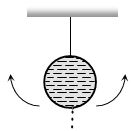
- 4View SolutionA simple pendulum is made of a body which is a hollow sphere containing mercury suspended by means of a wire. If a little mercury is drained off, the period of pendulum will
- 5A particle of mass $m$ is performing linear simple harmonic motion. Its equilibrium is at $x = 0,$ force constant is $K$ and amplitude of $SHM$ is $A$. The maximum power supplied by the restoring force to the particle during $SHM$ will beView Solution
- 6A particle executes simple hormonic motion between $x =\, -A$ and $x = +A$ . It starts from $x = 0$ moves in $+x-$ direction. The time taken for it to move from $x = 0$ to $x = \frac {A}{2}$ is $T_1$ and to move from $\frac {A}{2}$ to $\frac {A}{\sqrt 2}$ is $T_2$ , thenView Solution
- 7A simple pendulum has time period $T$. The bob is given negative charge and surface below it is given positive charge. The new time period will beView Solution
- 8Two particles $P$ and $Q$ describe simple harmonic motions of same period, same amplitude, along the same line about the same equilibrium position $O.$ When $P$ and $Q$ are on opposite sides of $O$ at the same distance from $O$ they have the same speed of $1.2 \,m/s$ in the same direction, when their displacements are the same they have the same speed of $1.6\, m/s$ in opposite directions. The maximum velocity in $m/s$ of either particle isView Solution
- 9The maximum velocity of a simple harmonic motion represented by $y = 3\sin \,\left( {100\,t + \frac{\pi }{6}} \right)$is given byView Solution
- 10A vertical mass-spring system executes simple harmonic oscillations with a period of $2\,s$. A quantity of this system which exhibits simple harmonic variation with a period of $1\, s$ isView Solution